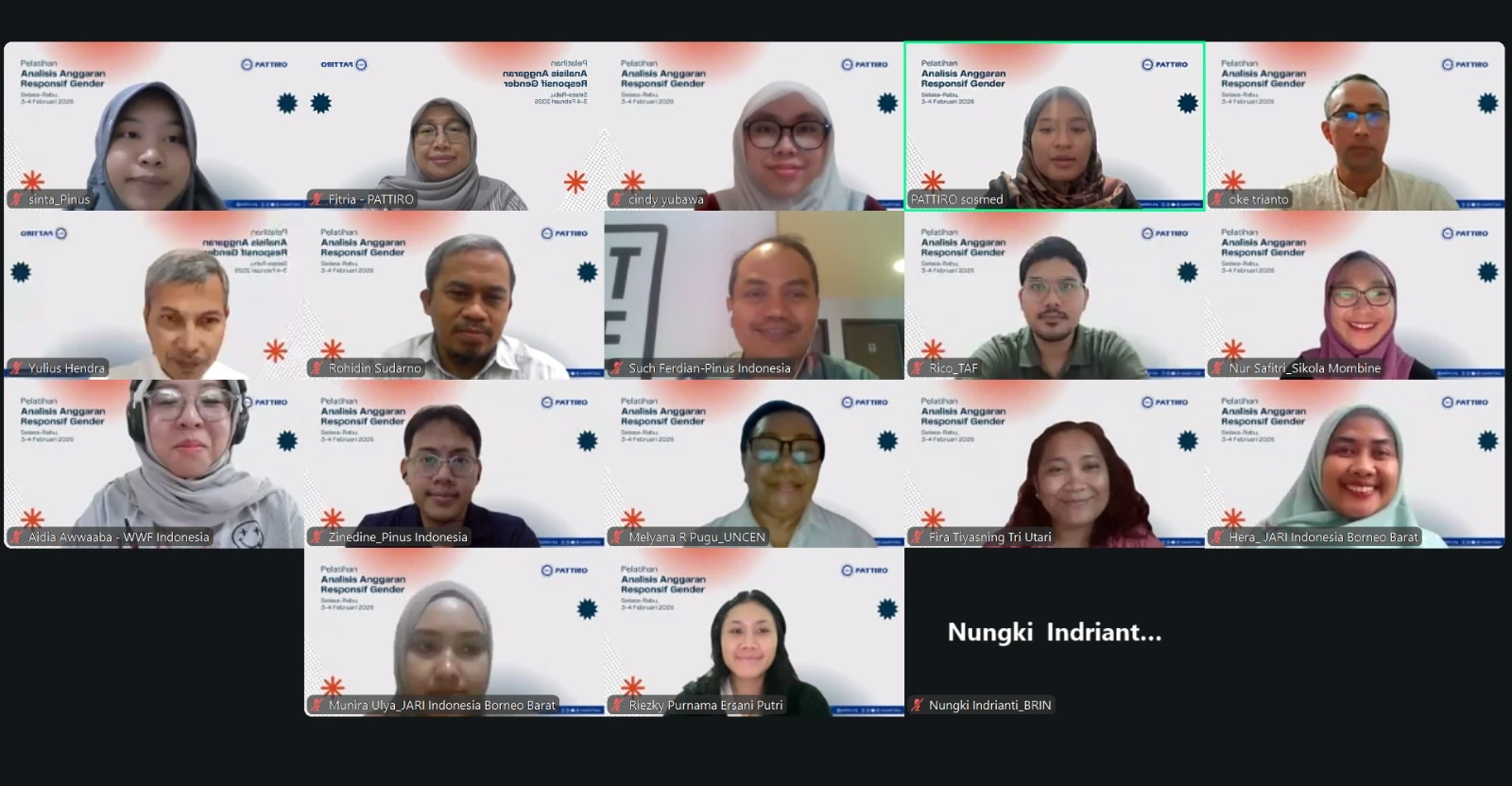
Gender Mainstreaming (GMS) continues to face various implementation challenges, particularly at the development planning and budgeting stages. To address these challenges, PATTIRO organized an online Gender-Responsive Budgeting Analysis Training on Tuesday and Wednesday (February 3–4, 2026), as part of an effort to strengthen the understanding and technical capacity of stakeholders.
The event was attended by 18 participants representing civil society organizations (CSOs), academia, and government officials. This training aimed to deepen participants’ understanding of gender concepts and GMS, while simultaneously encouraging the revitalization of GMS implementation through technical capacity building, particularly in conducting gender analysis.
Over the two-day session, participants received comprehensive materials covering: (1) Gender Concepts, (2) Gender Mainstreaming in Development, (3) Gender-Responsive Planning and Budgeting (GRPB) and Gender-Responsive Budgeting (GRB), (4) Gender Analysis, and (5) The Revitalization of Gender Mainstreaming. The materials were delivered interactively, complemented by discussions and analytical exercises based on real-world field issues.
During the discussion and analysis sessions, several strategic issues were raised as learning cases, including gender issues in social forestry, gender inequality in access to MSME assistance funds, gender disparity in employment, and other gender issues relevant to local development contexts.
The training received positive feedback from participants. One participant from Jayapura Regency, Rico Takai Yama, noted that the training process was engaging and provided a space for in-depth learning.
“The process was enjoyable; I hope there will be a follow-up training. I am particularly interested in more profound and technical discussions regarding the entire GMS process, the GMS Working Group, the linkage between national and regional policies, and other knowledge that can assist NGOs/CSOs in determining strategies and advocacy,” he remarked.
Positive sentiments were also shared by Hera Yulita, a participant from Pontianak.
“It was pleasant. Besides refreshing, updating, and upgrading my knowledge and understanding of Gender, GMS, and GAP (Gender Analysis Pathway), I also gained many insights from the discussions, both from the speakers’ presentations and the dialogue between participants,” she stated.
This activity is a manifestation of PATTIRO’s commitment to supporting the acceleration of GMS implementation across various development sectors by enhancing stakeholder capacity. Through this training, PATTIRO hopes that participants will not only understand concepts and theories but also become drivers for gender equality through development policies and programs that are more inclusive and equitable in their respective regions.
Technical Glossary
To ensure alignment with international development standards, the following keywords have been utilized:
- Pengarusutamaan Gender (PUG): Gender Mainstreaming (GMS).
- Perencanaan dan Penganggaran Responsif Gender (PPRG): Gender-Responsive Planning and Budgeting (GRPB).
- Anggaran Responsif Gender (ARG): Gender-Responsive Budgeting (GRB).
- Organisasi Masyarakat Sipil: Civil Society Organizations (CSOs).
- Perhutanan Sosial: Social Forestry.