Book

Books made by PATTIRO

Our Money, Our Responsibility

Public budget is one of the important issues addressed by the government. Public budget involves many issues, from education to health care, to the tax that significantly related to people’s lives. In the last decade the world witnessed an explosion of citizen and civil society group’s interest in public budget issue, either through budget analysis,

Our Money, Our Responsibility Read More »

Budget Advocacy Training Module For CSO (Civil Society Organization)

This book is a Regional Planning and Budgeting Training Module developed by AIPD (Australia Indonesia Partnership for Decentralisation) to support capacity-building for CSOs (Civil Society Organizations), particularly in eastern Indonesia (Papua, West Papua, NTT, NTB, and East Java). Key points by section: A. Module Development — The module was developed because AIPD views participatory planning

Budget Advocacy Training Module For CSO (Civil Society Organization) Read More »

Implementation Guide for Gender-Responsive Planning and Budgeting at the Regional Level

Summary This book explains the concept of Gender Mainstreaming (Pengarusutamaan Gender/PUG) and its derivative, Gender-Responsive Planning and Budgeting (Perencanaan dan Penganggaran yang Responsif Gender/PPRG), within the context of Indonesia’s development policy. Key points: Definition of PUG — a strategy to integrate a gender perspective across the entire development policy cycle (planning, formulation, implementation, monitoring, evaluation),

Implementation Guide for Gender-Responsive Planning and Budgeting at the Regional Level Read More »

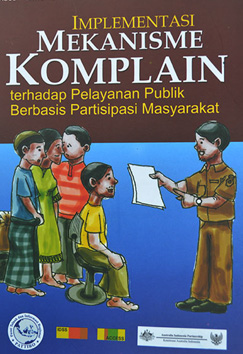
Implementing a Community-Based Complaint Mechanism for Public Services

Starting in November 2005, the Center for Regional Information and Studies (PATTIRO) implemented the program “Developing a Community-Based Complaint Mechanism for Public Services.” The program was carried out in three cities on the island of Java: Tangerang City in Banten Province, Semarang City in Central Java Province, and Malang City in East Java Province. Two

Implementing a Community-Based Complaint Mechanism for Public Services Read More »

Public Service for Persons with Disabilities (A Review of Good Practices and Innovation from Partners of the Peduli Pilar Disabilitas Phase 1 Program (2015-2016) in Five Provinces in the Public Service Sector)

According to the International Disability and Development Consortium (IDDC), inclusive development is a process of ensuring that all marginalized groups, including persons with disabilities, can take part in development and enjoy its benefits. This paradigm emerged because, since the 1980s, development has relied too heavily on economic growth, leading to social deprivation. Inclusive development in

Public Service for Persons with Disabilities (A Review of Good Practices and Innovation from Partners of the Peduli Pilar Disabilitas Phase 1 Program (2015-2016) in Five Provinces in the Public Service Sector) Read More »

Disability Database Innovation (Review and Good Practices of Peduli Disabilitas Program Partners Phase 1 in Six Provinces)

In inclusive and sustainable development, persons with disabilities need to be actively involved and able to enjoy the benefits of development to the fullest. A key requirement is comprehensive, regularly updated disability data. Without accurate data, vulnerable groups find it even harder to obtain their rights and basic services. At present there is still no

Disability Database Innovation (Review and Good Practices of Peduli Disabilitas Program Partners Phase 1 in Six Provinces) Read More »

Law Annotation Book No. 30 of 2014 on Government Administration

Law No. 30 of 2014 on Government Administration (State Gazette of 2014 Number 292) is one of the laws supporting bureaucratic reform and good governance. This law provides the legal basis for governance, maintains the relationship between government officials and citizens, and creates improved, transparent and efficient bureaucracy. Thus, this Law is not only a

Law Annotation Book No. 30 of 2014 on Government Administration Read More »

Scroll to Top