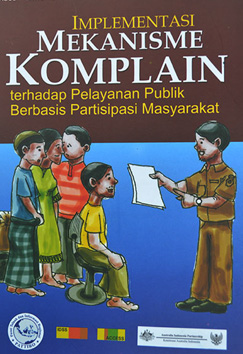
 Starting in November 2005, the Center for Regional Information and Studies (PATTIRO) implemented the program “Developing a Community-Based Complaint Mechanism for Public Services.” The program was carried out in three cities on the island of Java: Tangerang City in Banten Province, Semarang City in Central Java Province, and Malang City in East Java Province. Two months later, in February 2006, implementation began in Jeneponto and Bantaeng districts in South Sulawesi Province. In early April 2006, it was extended to West Lombok district in West Nusa Tenggara.
The program was grounded in the recognition that hopes for improved public service delivery under regional autonomy had yet to be fulfilled. The high expectations following the enactment of Law No. 22/1999 in 2001 had still not materialized. Regional governance had seen no meaningful improvement, space for community participation remained insufficiently open, and bringing public services closer to communities did not translate into better service quality.
Complaints remained widespread over the high cost of obtaining birth certificates, family cards, and ID cards. Families holding Health Insurance Cards for the Poor (Askeskin) often reported being treated rudely, dismissed, or even denied service on the grounds that available facilities were already full. The same held true in education, where School Operational Assistance (BOS) funds were still, in some cases, managed without transparency or community participation.
Based on these findings, the program aimed to strengthen community participation in public service delivery so that public services at the regional level would become higher in quality and more responsive to the needs of the poor and of women. The program’s approach involved organizing communities at the grassroots level, advocating for regional public service policies that favor community interests, and facilitating the implementation of complaint mechanisms within public service agencies at the regional level.
In implementing the program on the ground, PATTIRO worked with local non-governmental organizations (NGOs) or regional implementation teams considered to have strong understanding of local community conditions. On Java, it collaborated with the PATTIRO Raya network — PATTIRO Tangerang, PATTIRO Semarang, and PATTIRO Malang. In Jeneponto and Bantaeng districts, the program was implemented together with Regional Implementation Teams, whose members included representatives of district civil society working groups — the Turatea Civil Society Alliance (AMST) in Jeneponto and the Civil Society Network (Jaringmas) in Bantaeng. In West Lombok, PATTIRO’s partner was Solidaritas Perempuan Mataram.
At the regional level, the program worked with residents of 30 villages/urban wards, members of Regional People’s Representative Councils (DPRD), local government officials and staff, NGOs, academics, regional media, and other community organizations. At the community level, the program aimed to build people’s capacity to engage in public service delivery through the development of community centers.
Engagement and collaboration with local governments were aimed at advocating for the implementation of complaint mechanisms within various Regional Work Units (SKPD), such as offices and agencies, as well as Regional Technical Implementation Units (UPTD) — including community health centers (puskesmas) for health services, sub-district offices (kecamatan) for administrative services, and schools for education services. With policymakers at the DPRD and regional heads, engagement in the form of lobbying and discussion aimed to advocate for public policy — specifically, a draft Regional Regulation (Raperda) on Public Services to better guarantee residents’ rights to higher-quality public services. This policy advocacy process was carried out together with other civil society organizations — fellow NGOs, academics from universities, the media, and community-level institutions.
Community participation at the grassroots level was channeled through community centers established in 29 villages/urban wards. Most of these centers have taken on a role in advocating for the submission of community complaints, participating in meetings with local governments and DPRDs, and even engaging in policy advocacy together with other civil society organizations.
The technical assistance process with local governments has led to the implementation of complaint mechanisms in several community health centers in West Lombok; improvements to the Public Service Complaint Handling Center (P5) in Semarang City to make it more accessible to the public; the application of a complaint mechanism within the Semarang City Education Office for monitoring new student admissions; and a positive shift in behavior in Tangerang City. Licensing agencies that previously provided no information on administrative procedures or costs have since made efforts to build transparency — for instance, sub-district offices now display information boards with instructions for processing birth certificates, family cards, and ID cards.
As for policy advocacy in the form of proposed draft Regional Regulations on Public Services, two such drafts have gone through the proposal process: in Malang City, where deliberation has begun in a Special Committee, and in Jeneponto district, where the draft has been proposed but deliberation has not yet taken place. In the other four regions, draft regulations have not yet been successfully proposed, but have received positive support from stakeholders — civil society, local governments, and DPRD members alike.
It is, of course, reasonable to hope that community capacity will continue to grow, that institutions for community participation will be made available, and that an overarching policy will be put in place to guarantee people’s right to quality public services as well as their right to participate.