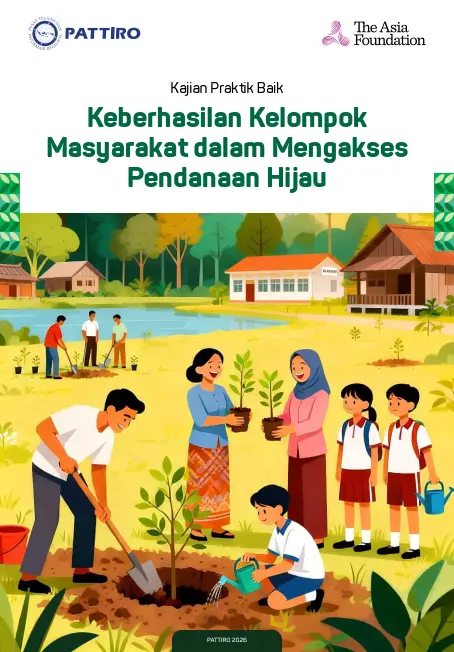
 For years, numerous indigenous communities, community groups, local organizations, and environmental advocates have worked to safeguard forests, rivers, coasts, natural springs, and biodiversity with severely limited resources. They possess the knowledge, dedication, and willingness to act. What they often lack is simply access to funding.
The Public Fund Service Program for the Environment (FOLU Small Grants), initiated by the Ministry of Forestry, was established to bridge this gap. Through a grant scheme, the government offers opportunities for local communities, civil society groups, and organizations to secure financial support toward achieving Indonesia’s FOLU Net Sink 2030 targets. This program serves as a direct form of climate financing that positions local communities as the primary actors in environmental protection and restoration.
This commitment is backed by a bilateral partnership between Indonesia and Norway valued at up to IDR 800 billion. These funds are directed toward supporting thousands of community initiatives across various regions through three main tracks: FOLU Goes to School, which fosters school engagement in environmental conservation; FOLU Terra, which enhances community welfare through sustainable environmental management; and FOLU Biodiversity, which focuses on the protection and restoration of biodiversity.
However, a substantial financial commitment does not automatically mean that all communities can access it easily. As of March 2026, following four implementation stages, total disbursed funds reached approximately IDR 26.31 billion. This figure indicates that the program still has a long road ahead, while offering valuable learning opportunities to enable more community groups to access funding in subsequent phases.
This book was not compiled merely to celebrate a program’s achievements. Beyond that, it records the journeys of the people behind the efforts to protect and restore the environment. Within these pages, readers will discover stories of indigenous women protecting forests through trigona stingless beekeeping; coastal communities combining shoreline rehabilitation with sea turtle conservation; community forums restoring riverbanks; youth groups protecting freshwater springs; mountain-climbing communities reforesting high-altitude landscapes; and civil society organizations transforming former mining sites into spaces for new growth. Though coming from diverse backgrounds, they are united by a common conviction: local communities are the principal actors in environmental stewardship.
Their journeys were not always smooth. This book tells how information on funding opportunities was often discovered by chance; how proposals were drafted amid limited internet access and administrative capacity; and how communities navigated multiple revisions, site adjustments, disbursement delays, and field challenges. All of these obstacles had to be overcome before the first tree was planted, the first bee colony established, or the first site restored. It is precisely through this series of challenges that the most valuable lessons were forged.
This volume documents the funding access stage and early implementation phase of twelve community group recipients under Stage 4 of the FOLU Small Grants. At the time of writing, some groups have completed their primary activities and generated immediate outputs, others are underway, and some are awaiting field execution following grant approval. Due to the short duration of program operations so far, this book cannot and does not intend to evaluate medium- or long-term environmental, social, or economic impacts. The term “best practice” used in the title and throughout the stories is applied in an operational sense—referring to “promising or good practices during the funding access and early implementation stages”—rather than practices whose long-term impacts have been fully tested and validated.
Ultimately, this book demonstrates that in many places, communities already possess the ideas and solutions to safeguard their environments. The challenge lies in ensuring they have access to information, opportunities, mentoring, and funding to realize those ideas. The twelve stories in this book illustrate how the distance between community initiatives and funding sources can be narrowed. They contain narratives of community perseverance, learning processes, mentorship, collaboration, and the courage to take the first step. PATTIRO played a vital role in this journey by opening access, connecting communities with funding opportunities, and strengthening their capacity to navigate the application process.
May the experiences of these twelve communities serve as a learning resource for other community groups, a reference for mentoring organizations, and constructive input for the government and fund managers to continue building environmental funding mechanisms that are increasingly open, inclusive, understandable, accessible, and responsive to community needs.