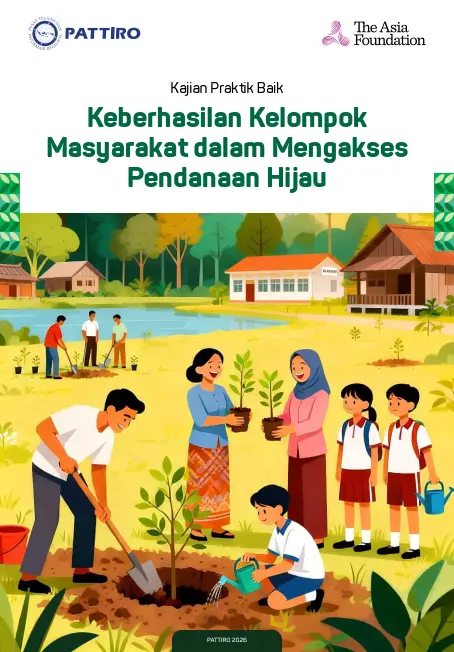
 Achieving the FOLU Net Sink 2030 target requires the involvement of communities who live around forest areas. In its Enhanced NDC, Indonesia targets an emission reduction of 31.89% through its own efforts and 43.20% with international support by 2030. The FOLU sector makes the largest contribution, at 54.6% of the target with its own efforts and 58.8% of the target with international support. To support community initiatives on the ground, the Environmental Fund Management Agency (BPDLH) and the Ministry of Forestry provide the Community Fund Service (LADAMA) through a Small Grant scheme, supported by Indonesia–Norway cooperation funds. Of Norway’s total contribution of USD 216 million, around USD 5 million (2.3%) is allocated to community-scale activities. As of Period IV, LADAMA has disbursed around Rp29.08 billion to 863 community groups.
However, the availability of a funding scheme does not guarantee equitable access. Since November 2025, PATTIRO has assisted 75 communities in LADAMA Batch 4. As of April 2026, only 12 communities (16%) had been designated as recipients, with total funding of Rp506.66 million, while 63 communities (84%) had not yet received funding. Of the 12 recipients, seven are from Java, four from Sulawesi, and one from Sumatra, and there are no recipients yet from Kalimantan, Bali–Nusa Tenggara, Maluku, and Papua. A similar pattern appears in Batches 1–3, when recipients were concentrated in West Java (106 groups), Central Java (68), and East Java (64), while Maluku and Papua had only 2 groups each. These findings come from the communities PATTIRO assisted, so they are not meant to describe the national distribution of all recipients.
PATTIRO’s assistance revealed several barriers. A uniform digital procedure creates unequal access burdens for communities with limited signal and devices. Differences in prices and distribution costs across regions make it hard to prepare Budget Plans (RAB). In Masewo, for example, seedlings cost around Rp20,000, transport costs Rp5,000 per seedling, and a motorbike taxi from Gimpu District costs Rp400,000 per person one way. Uncertain disbursement schedules disrupt activity cycles, and information at one partner bank branch was not consistent. In addition, recipient data is not yet disaggregated by gender and disability, so the barriers faced by vulnerable groups cannot yet be identified and monitored.
Based on these findings, this policy brief proposes four improvement agendas: strengthening affirmative access for vulnerable groups and regions, budgeting guidelines that respond to local conditions, certainty and accountability in fund disbursement, and harmonized information and disbursement procedures through partner banks. These recommendations are directed primarily at the Ministry of Forestry and BPDLH, with partner banks involved in disbursement services. Good practices from recipient communities can also be institutionalized, including programs based on real local needs, multi-stakeholder collaboration, adaptation amid constraints, and member participation. One example is KTH Bujung Pujung Lestari, where 48 of 89 members (54%) are women involved in decision-making. Expanding community-based funding access is not achieved by building recipient capacity alone. The design of the LADAMA service also needs to be more adaptive.