
Description
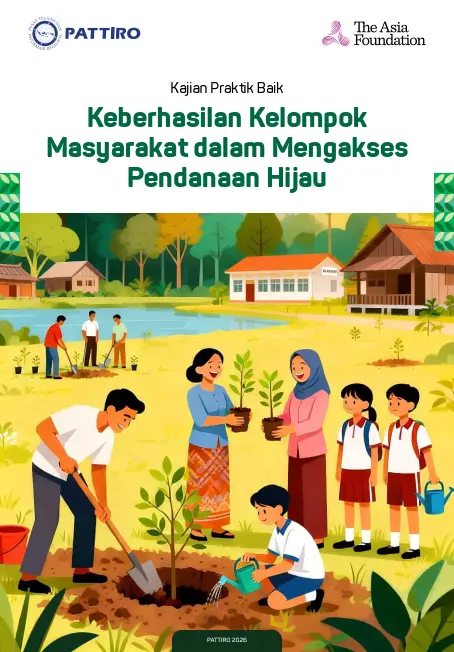
We offer our highest praise and gratitude to God Almighty for the publication of this book. This volume documents the inspiring journey of twelve local communities from across Indonesia that successfully accessed Stage 4 of the Public Fund Service Program for the Environment (FOLU Small Grants), administered by the Ministry of Forestry and the Environmental Fund Management Agency (BPDLH). Far beyond a collection of success stories, this book serves as tangible proof that local communities are the true frontline actors in environmental protection and restoration.
For over two decades, PATTIRO has dedicated itself to accompanying communities, strengthening local governance, and fostering participatory development. This extensive field experience underscores a fundamental truth: communities possess deep-rooted knowledge and practical solutions to their own environmental challenges. The primary obstacle rarely lies in community capacity, but rather in systemic barriers to information, financial resources, and opportunities to scale their initiatives.
The FOLU Small Grant Program has created vital new pathways for grassroots communities to access environmental financing directly. In partnership with The Asia Foundation, PATTIRO has mentored 75 communities since late 2025—guiding them through program literacy, proposal development, and administrative compliance. While 12 communities ultimately secured grant funding through this rigorous process, the true measure of success extends far beyond numbers. It lies in the enhanced institutional capacity of these communities, their elevated confidence in navigating public finance, and the deepened collaboration established among civil society, government, and key stakeholders.
Within these pages, readers will explore diverse best practices: from safeguarding customary forests and protecting sea turtle nesting grounds to rehabilitating riverbanks, preserving natural springs, reforesting watersheds, and restoring post-mining lands. Unifying these distinct efforts is a single core principle: sustainable change takes root when communities are entrusted with the space, resources, and leadership to shape their own environment.
We extend our deepest appreciation to the Ministry of Forestry, the Environmental Fund Management Agency (BPDLH), The Asia Foundation, regional governments, field mentors, and all participating communities whose commitment has enriched this initiative. May this publication serve not only as a record of achievement, but also as a catalyst for other communities, a constructive reference for policy development, and a steadfast reminder that empowering local action remains the most vital investment for our planet.
We hope this book offers meaningful insights. May each narrative within it reaffirm our conviction that the future of Indonesia’s forests, rivers, coastal regions, and landscapes depends upon the resilience and strength of the communities that steward them.