The central government, through Law Number 1 of 2022 concerning Financial Relations between the Central Government and Regional Governments (HKPD Law), has set a maximum limit for employee expenditure of 30% of the total Regional Budget (APBD) starting from the 2027 fiscal year. This policy is considered burdensome for many regional governments amidst fiscal pressures due to a decline in transfers to regions (TKD) since 2024. Additionally, the national policy of mass, mandatory appointment of Government Employees with Work Agreements (PPPK) has significantly increased the burden of employee expenditure.
This situation places regional governments in a policy dilemma between the demand to comply by reducing employee expenditure and the obligation to pay the salaries of already appointed State Civil Apparatus (ASN) and PPPK.
Fitria Muslih, Executive Director of PATTIRO, revealed that regional governments will find it difficult to comply with the 30% employee expenditure limit due to vertical fiscal imbalance. According to Fitria, the amount of Regional Original Revenue (PAD) is too small to cover operational expenditures and employee salaries. Dependence on TKD makes the fiscal maneuver space very limited when central transfers decrease. This was revealed in the Local Governance Forum entitled “Challenges in Implementing the 30% Employee Expenditure Limit Amidst Fiscal Pressure for the 2027 Budgeting: Are Regions Ready?” organized online by PATTIRO on Wednesday (13/05/2026).
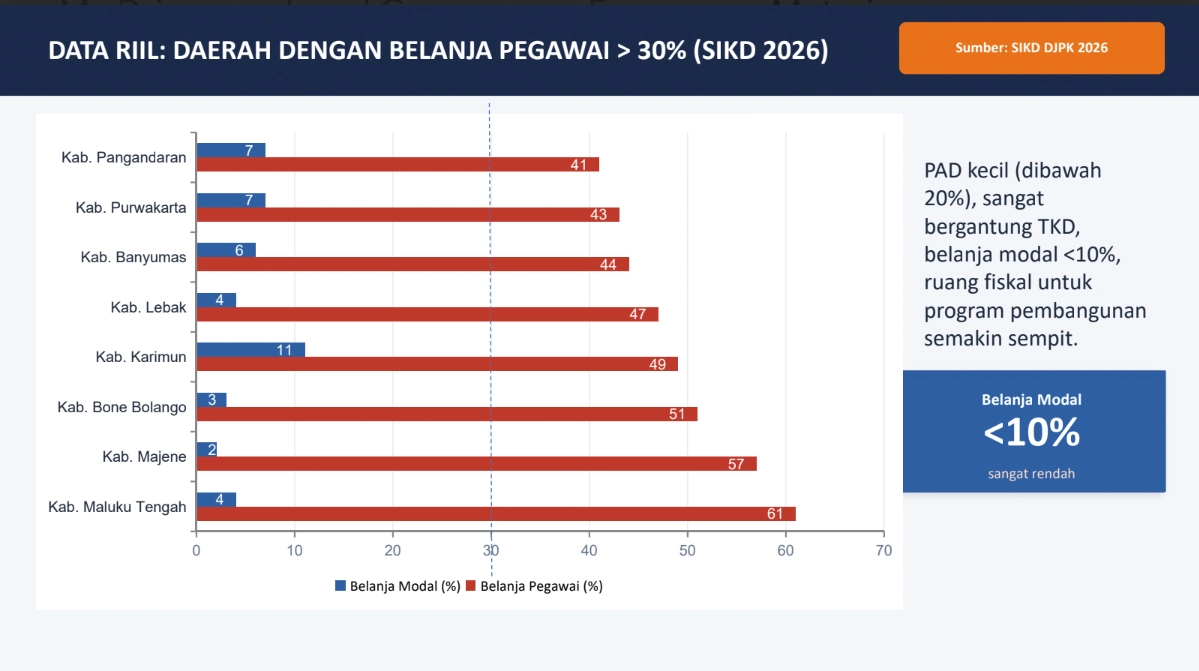
This real dilemma is clearly visible in Bone Bolango Regency, Gorontalo Province. Sri Mulyani Lalijo, Head of Bappedalitbang, explained that employee expenditure in her region has now reached 51% in 2026, far exceeding the set limit. This figure jumped by 10% from 2024 after the regional government appointed 1,070 full-time PPPK and 1,830 part-time PPPK, which drove an increase in employee expenditure of IDR 42 billion from IDR 404 billion in 2024 to IDR 447 billion in 2026.
“From the remaining budget of IDR 459 billion, we must cover other mandatory expenditures: infrastructure, education, health, and other sectors. As a result, infrastructure expenditure has not reached 18%, still far from the central government’s target of 40%,” Sri revealed.
Banyumas Regency experienced a similar situation. Dedy Noerhasan, Head of Bapperida of Banyumas Regency, stated that employee expenditure reached 35.9%. Although not as high as Bone Bolango, this figure still exceeds the limit set by law.
High Employee Expenditure, Suppressed Capital Expenditure
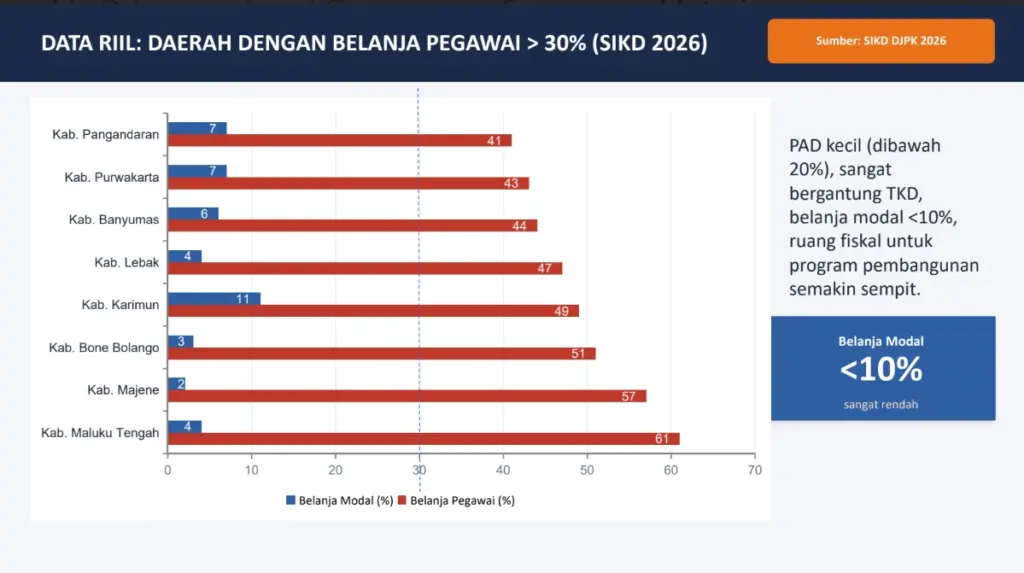
Data from PATTIRO shows that significant imbalances still exist between employee expenditure and capital expenditure in several regions. The high proportion of employee expenditure results in limited fiscal space for infrastructure development and public services. This can be seen from the minimal budget allocation for capital expenditure. Many regions allocate capital expenditure below 10%, and some only allocate 2%, such as Majene Regency.
In response to this condition, Ernest Rakinaung, Sub-Coordinator of Technical Support for Transfer Facilitation and Regional Debt Financing at the Ministry of Home Affairs, stated that based on the Regional Government Information System (SIPD), the average regional employee expenditure in 2025 reached 36.3 percent and increased to 41.4 percent in 2026.
“There are 140 regions considered capable of meeting minimum expenditure, whether it’s mandatory expenditure, 30% employee expenditure, 40% infrastructure expenditure, or 20% education expenditure,” Ernest said.
According to Ernest, the policy of limiting employee expenditure to 30% encourages regional governments and the central government to be more creative in developing regional potential as new sources of financing. He added that the future direction of TKD policy will continue to prioritize public service spending.
Regions Move with Their Own Strategies
On the ground, regional governments are not standing still in response to central policies. Bone Regency, South Sulawesi, has chosen an adaptive bureaucratic restructuring path through a zero-growth policy, meaning no new employee appointments except for truly priority basic service positions. Muh. Kafrawi Samad, Young Planning Expert at Bappeda Bone, explained that this strategy is implemented without mass layoffs of PPPK or honorary staff, but through rationalizing the need for functional positions.
“What the Regent of Bone prioritizes is expenditure efficiency, meaning expenditures that can be rationalized, we rationalize. Those truly needed for public services are maintained,” Kafrawi explained.
On the revenue side, Bone Regency strengthens PAD through expanding tax and levy objects, digitalizing services, optimizing the utilization of regional assets, and strengthening information technology-based supervision.
The same strategy is being implemented by the Banyumas regional government; they have started optimizing PAD potential to compensate for the decrease in TKD.
“Our strategy is to postpone the conversion of part-time appointments to full-time, while increasing PAD by exploring existing potential,” Dedy revealed.
He hopes the central government will provide tolerance regarding sanctions for regions that have not yet been able to meet the 30% employee expenditure target, as regional governments still need time for adjustment following the decrease in TKD.
Responding to the strategies implemented by regions, Fitria assessed that for regions with low PAD (below 20%), even though they have tried to optimize PAD, this step is considered insufficient to compensate for the decline in TKD because they are still constrained by various regulations and limited regional authority.
“Regions with low PAD are currently increasingly dependent on TKD. These regions have actually started making various efforts to optimize PAD, but many are still constrained by regulations and authority, making it difficult to compensate for the decline in TKD,” Fitria said.
PATTIRO assesses that the successful implementation of the 30% employee expenditure limit policy requires adaptive transitional policy support, strengthening regional fiscal capacity, and close coordination between the central and regional governments so that public services and development continue to run optimally.
PATTIRO Recommends Fiscal Clustering as a Fair Transition Solution
Amidst the diverse realities concerning the 30% employee expenditure limit, PATTIRO has conveyed policy recommendations. Fitria emphasized that a uniform approach to this policy is a structural error.
“The fiscal conditions and revenue structures of regions are very different and cannot be generalized. Many regions still depend on TKD because their PAD has not been able to cover regional operational needs,” Fitria said.
PATTIRO proposes that the central government implement regional fiscal capacity clustering as the basis for a transition mechanism. This clustering does not merely divide regions based on the size of their APBD, but specifically needs to consider two critical aspects: first, PAD capacity as a reflection of the region’s real fiscal independence; and second, the level of dependence on TKD, which indicates how vulnerable the region’s finances are to central transfer policies.
Based on these two aspects, regions can be grouped into different clusters, namely:
- Independent regions with high PAD and low TKD dependence;
- Transition regions with medium PAD and medium TKD dependence;
- Vulnerable regions with low PAD and very high TKD dependence.
Each cluster is then given different, gradual, and proportional targets for reducing employee expenditure.
“Regions that are more fiscally independent can be targeted to reach the 30% limit more quickly. Meanwhile, regions that are still highly dependent on TKD need to be given a longer roadmap, accompanied by technical assistance support from the center to strengthen their PAD,” Fitria explained.
Besides clustering, PATTIRO also proposes that the government develop a performance-based incentive scheme for regions that successfully adjust employee expenditure to 30%, not merely provide punishment.
Responding to PATTIRO’s recommendations, Ernest said that in response to this issue, the Ministry of Home Affairs, the Ministry of Finance, and the Ministry of Administrative and Bureaucratic Reform have held joint discussions. They agreed to extend the transition period for meeting the 30% policy, which will be regulated in a revision of the State Budget Law.