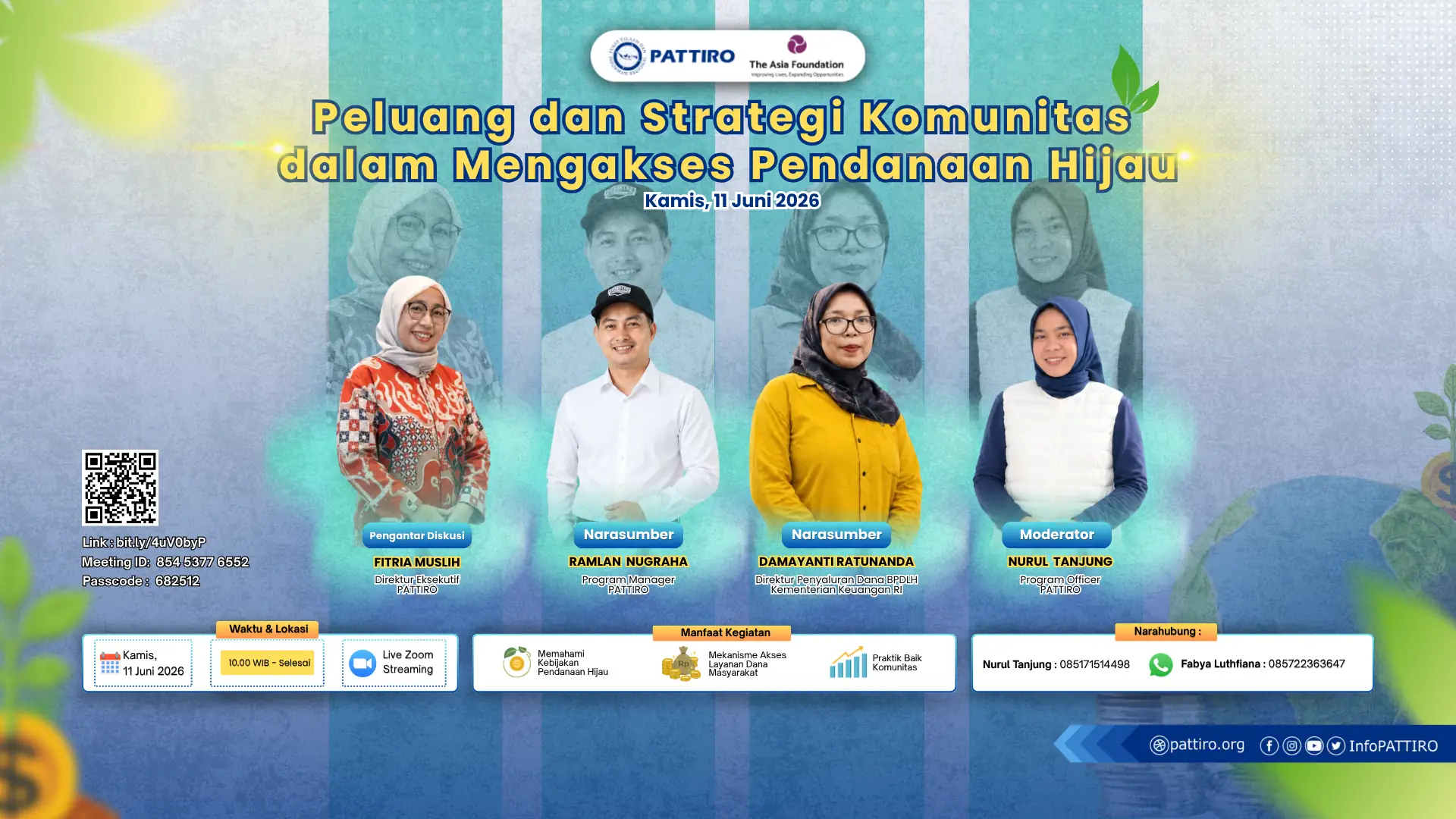
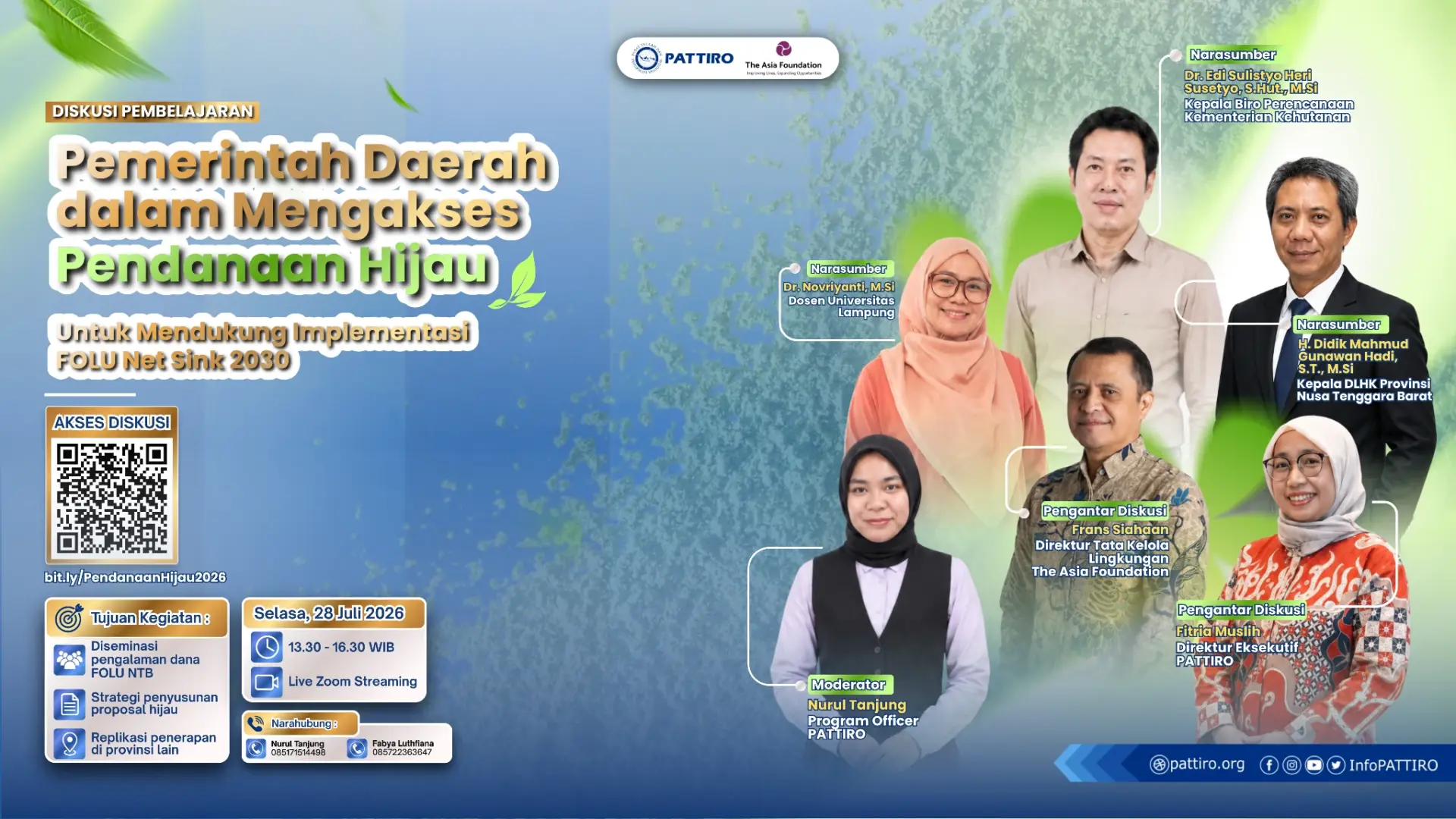
Jakarta, 28 July 2026 – With support from The Asia Foundation, PATTIRO held a Learning Discussion for Local Governments on Accessing Green Financing to Support the Implementation of FOLU Net Sink 2030. Held online, the forum featured speakers from the Ministry of Forestry, BPDLH, and the Head of the West Nusa Tenggara (NTB) Provincial Environment Agency, and was attended by more than 100 participants from local governments, academia, civil society organizations, development partners, and communities.
The discussion drew on the experience of the West Nusa Tenggara (NTB) Provincial Government in accessing FOLU Result-Based Contribution financing. NTB’s experience shows that access to green financing is determined not only by the availability of financing schemes, but also by institutional readiness, data quality, clarity of location, leadership commitment, and the ability to build collaboration.
The forum affirmed that green financing should not simply be understood as additional budget, but is meant to strengthen regional governance, restore ecosystems, build community capacity, and ensure that the national climate agenda is translated into concrete action on the ground.
Limited Regional Budgets Push Local Governments to Seek New Financing Sources
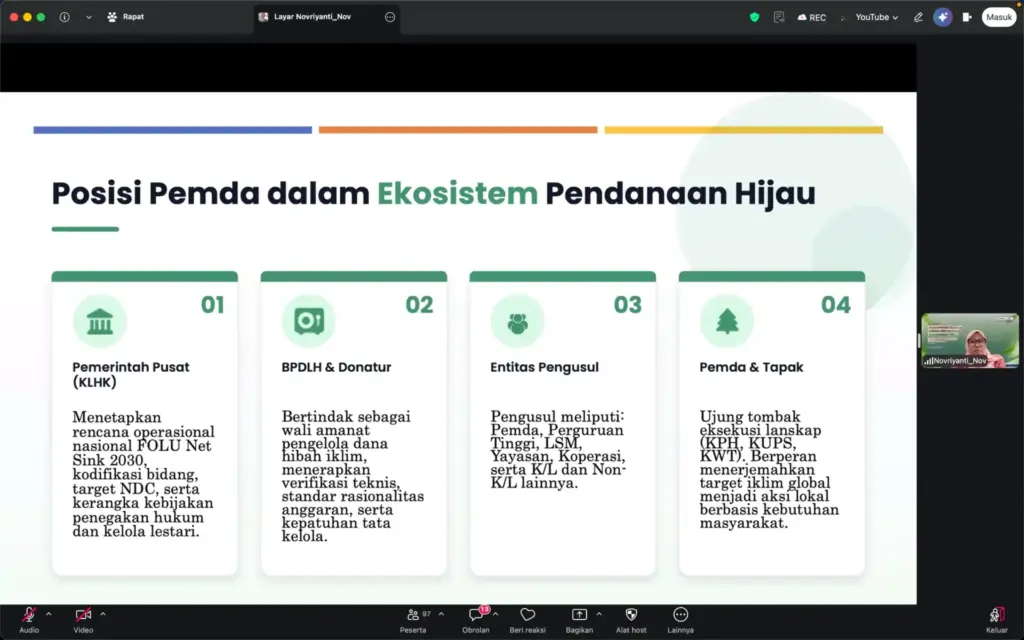
Local governments hold a strategic position in achieving FOLU Net Sink 2030, since most forest protection, land rehabilitation, carbon stock enhancement, and community empowerment actions take place at the regional level. However, fiscal space in regional budgets (APBD) is increasingly limited, while financing needs in the forestry and land-use sector remain very large.
Fitria explained that provincial governments’ authority in forest management needs to be matched with the ability to seek funding sources beyond the regional budget.
“Achieving climate targets does not depend on the central government alone. Local governments hold a strategic position because Law No. 23 of 2014 grants provincial governments fairly clear authority in forest management,” said Fitria.
According to her, fiscal constraints require regions to explore various alternative financing schemes. One such opportunity is the FOLU RBC (Result-Based Contribution) from the Government of Norway, managed through the Environmental Fund Management Agency (BPDLH). This scheme originates from result-based contributions tied to Indonesia’s emission reduction achievements and is reinvested to support further action in the forestry and land-use sector.
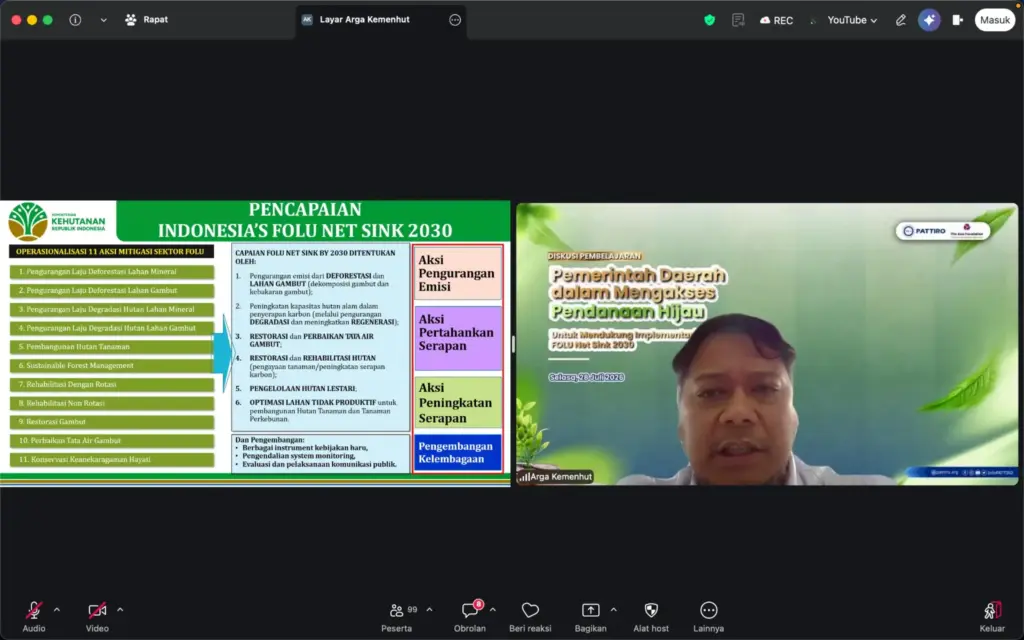
Arga Praditas Sutiyono of the RBC FOLU Norway Unit at the Ministry of Forestry explained that financing needs for FOLU exceed Rp200 trillion, while the contribution funds available remain limited, meaning their use must be carefully directed toward priority programs.
“That amount matters, but it is still small compared to the total need. Because funds are limited, proposals must select locations and activities that are truly a priority and deliver measurable impact,” explained Arga.
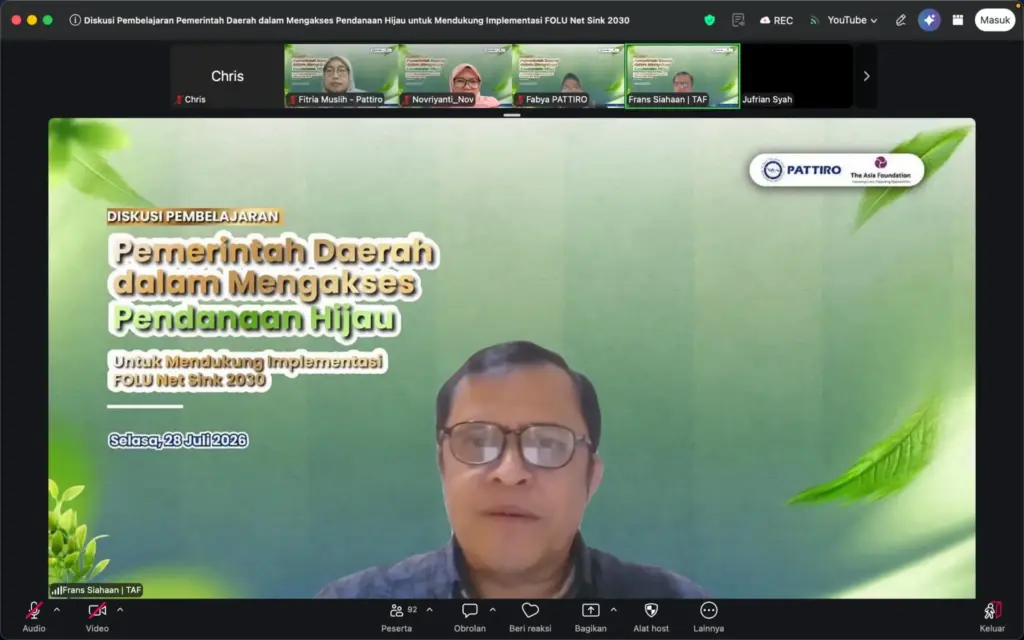
Frans Siahaan, Director of Environmental Governance at The Asia Foundation, added that local governments need to turn planning documents into concrete action.
“Subnational FOLU Net Sink work plans must not remain mere documents — they need to be implementable. The problem is that regional fiscal capacity is currently very limited. That is why innovation and new approaches are needed to tap into financing opportunities beyond routine budget sources,” said Frans.
Besides RBC FOLU, other opportunities include the Green Climate Fund, Global Environment Facility, and Adaptation Fund. However, these opportunities cannot be accessed simply by relying on general ideas. Each scheme has its own requirements, verification processes, and accountability standards that must be met.
NTB’s Experience Shows the Importance of Commitment and Collaboration
The NTB Provincial Government submitted a funding proposal around 2024, but the proposal was not successful. This experience shows that local governments may have good ideas, yet still face difficulties if they do not yet understand the submission mechanism, requirements, and entry points for financing.
H. Didik Mahmud Gunawan Hadi, Head of the NTB Provincial Environment and Forestry Agency, acknowledged that the local government was initially still learning the FOLU financing mechanism.
“At that time, we had only just begun to understand the mechanism, so the first proposal did not succeed. That experience showed how important entry points and mentoring are. There are quite a few environmental funding sources, but regions need to understand how to access them,” explained Didik.
After discussions with PATTIRO, the NTB Provincial Government began carrying out assessments, consultations, workshops, and gradual proposal revisions. The initial proposal on managing the Rontu watershed was then developed into a collaborative, integrative, landscape-based watershed restoration intervention strategy in Bima and Dompu.
Didik explained that the program grew out of real problems, such as land degradation from monoculture corn farming, deforestation, loss of habitat for endemic wildlife, weak coordination between government bodies, and limited rehabilitation budgets.
“In the past, a few hours of rain would not necessarily cause flooding. Now, even shorter bursts of rain can trigger flooding in the Bima area because the watershed’s carrying capacity has declined. Interventions need to be carried out from upstream to downstream to restore watershed function,” Didik explained.
The NTB proposal was then directed toward rehabilitating around 200 hectares of social forestry area, building nurseries, monitoring plantings, protecting the area, developing social forestry group enterprises, and strengthening community institutions. The proposed budget, after revision, reached around Rp9.41 billion.
According to Didik, one of the most important lessons is that proposal development cannot be carried out by a single regional agency working in isolation.
“The main lesson from NTB’s experience is: don’t develop a proposal alone. Regions need to build a team, hold discussions with ministries, academics, and civil society partners, and be willing to revise repeatedly,” Didik stressed.
This experience shows that mentoring is not just about helping to write a proposal, but about testing the relevance of the problem, improving data, confirming the intervention location, developing indicators, and ultimately connecting community needs with national FOLU targets.
Proposals Must Address On-the-Ground Problems and Have Measurable Results
Arga further emphasized that green financing proposals are not merely administrative documents. A proposal must show the problem to be solved, the program location, the beneficiary groups, the implementing actors, indicators, budget, and verifiable results.
“A proposal is not just an administrative document. It must explain the on-the-ground problem, the objective, the actors involved, the implementation approach, and measurable results,” Arga stressed.
Dr. Novriyanti of the University of Lampung noted that many regional proposals fail not because the ideas are bad, but because the argumentation and program design are not yet fully developed.
“The background, problem, objective, outcome, output, activities, and indicators must be logically connected. One core problem should be directed toward one clear objective,” explained Novriyanti.
Local governments therefore need to begin proposal development from problem identification. A program should not be designed first and then forced to appear aligned with donor interests. A proposal must originate from the actual ecological and social problems faced by communities.
Institutional Readiness and Inclusivity Determine Sustainability
Leadership commitment at the regional level is one of the key factors in the green financing application process. Developing a proposal requires time, cross-sector coordination, adequate data, and a willingness to make repeated revisions.
Didik stressed that leadership support determines the regional team’s ability to carry the process through to the submission stage.
“Commitment from regional leadership is the most important thing. That support determines whether the team can collaborate with various agencies and segments of society, and carry the drafting process through until the proposal is submitted to the Ministry of Forestry,” explained Didik.
Fitria also stated that PATTIRO is open to supporting other regions, but the process must begin with the local government’s own internal readiness.
“Commitment from regional leadership, or political will, is a key requirement, because the proposal development process is fairly long and requires teamwork,” said Fitria.
Beyond institutional readiness, gender equality and social inclusion need to be placed as a core part of the program. In the NTB proposal, women were involved through social forestry groups and Farmer Women’s Groups to support natural resource management while also strengthening household economies.
Novriyanti emphasized that women, communities, and vulnerable groups must not be positioned merely as aid recipients.
“Communities, women, and vulnerable groups must become actors who drive change, not just recipients of aid. Their involvement is also the foundation for a program’s sustainability,” explained Novriyanti.
Sustainability must also be designed from the outset. A program should not stop once the grant period ends. Local governments need to consider integrating activities into the regional budget (APBD), developing community enterprises, access to banking, revolving funds, or other follow-on financing sources.
“A grant is meant to be a spark, not the only source of funding,” said Arga.
Novriyanti stressed that the measure of success for green financing does not lie solely in whether funds are disbursed.
“Green financing is not just a financial instrument — it is a means of building collaborative governance that connects policy with real action. A proposal must not simply be completed, the funds spent, and the activities come to a stop,” Novriyanti stressed.
The Role of District Governments and Communities Needs Clarification
The discussion also highlighted the position of district (kabupaten) governments. Representatives from Aceh Barat Daya and Siak districts noted that problems such as land conflict, fires, and ecosystem damage occur directly within district territory. However, districts often face constraints due to the division of forestry authority with provincial governments.
Arga explained that district and city governments can still submit proposals directly to the Minister of Forestry.
“Under the FOLU scheme, there is no prohibition on districts, cities, NGOs, or other entities submitting proposals directly to the Minister of Forestry,” explained Arga.
Besides the local government proposal pathway, community groups can access the Community Fund Service, or small grants. This pathway can be used by forest farmer groups, social forestry business groups, Climate Village Program (Kampung Iklim) groups, and other communities.
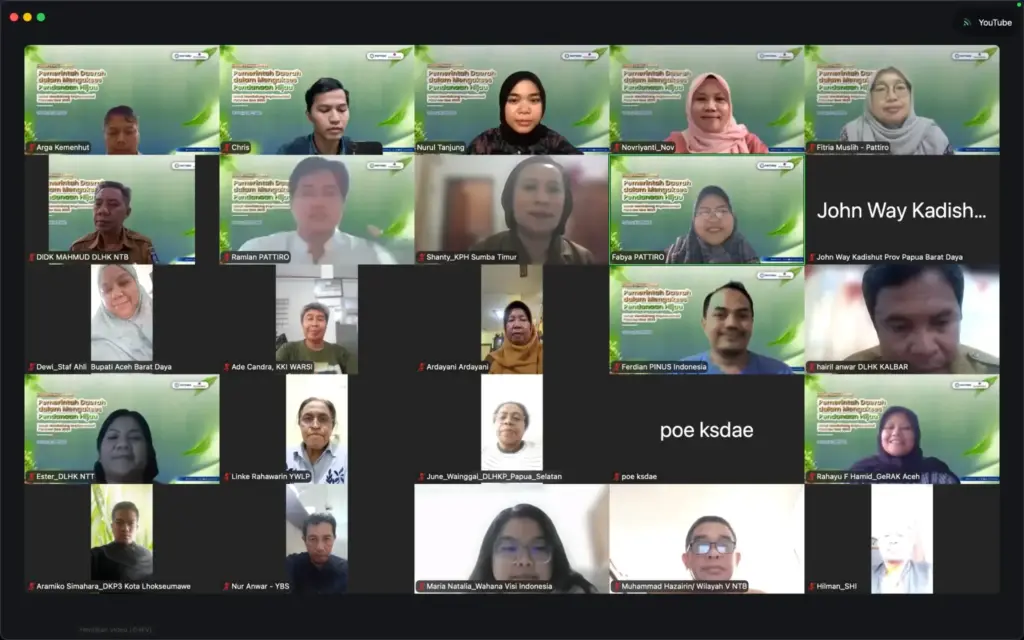
Through this forum, PATTIRO is encouraging local governments to build cross-agency green financing teams, prepare data and intervention locations, draw up a list of proposed programs before financing opportunities open, and involve academics, civil society organizations, and communities from the planning stage onward.
NTB’s experience shows that green financing opportunities are open to regions, but cannot be accessed instantly. Success requires leadership commitment, a clearly defined on-the-ground problem, accountable data, a well-measured proposal, and consistent collaboration.
With this kind of readiness, green financing can become a means of strengthening regional governance, restoring the environment, improving community welfare, and ensuring that FOLU Net Sink 2030 does not remain merely a national target, but truly delivers change on the ground.