The growing desire among young Indonesians to study, work, and build careers abroad cannot be seen merely as labor mobility. This phenomenon also reflects how young people assess job opportunities, research support, the quality of public services, and the space for freedom available at home.
The issue becomes more serious when those who leave are doctors, researchers, academics, and professionals needed to strengthen state institutions. Losing this educated group risks not only reducing innovation capacity, but also the quality of policymaking and public participation in democratic life.
At the same time, Indonesian democracy still faces challenges in civil liberties, political culture, government effectiveness, and openness to criticism. These conditions place Generation Z at a crossroads: seeking a future abroad, remaining within a system that does not yet fully support them, or continuing to contribute to Indonesia through knowledge and global networks.
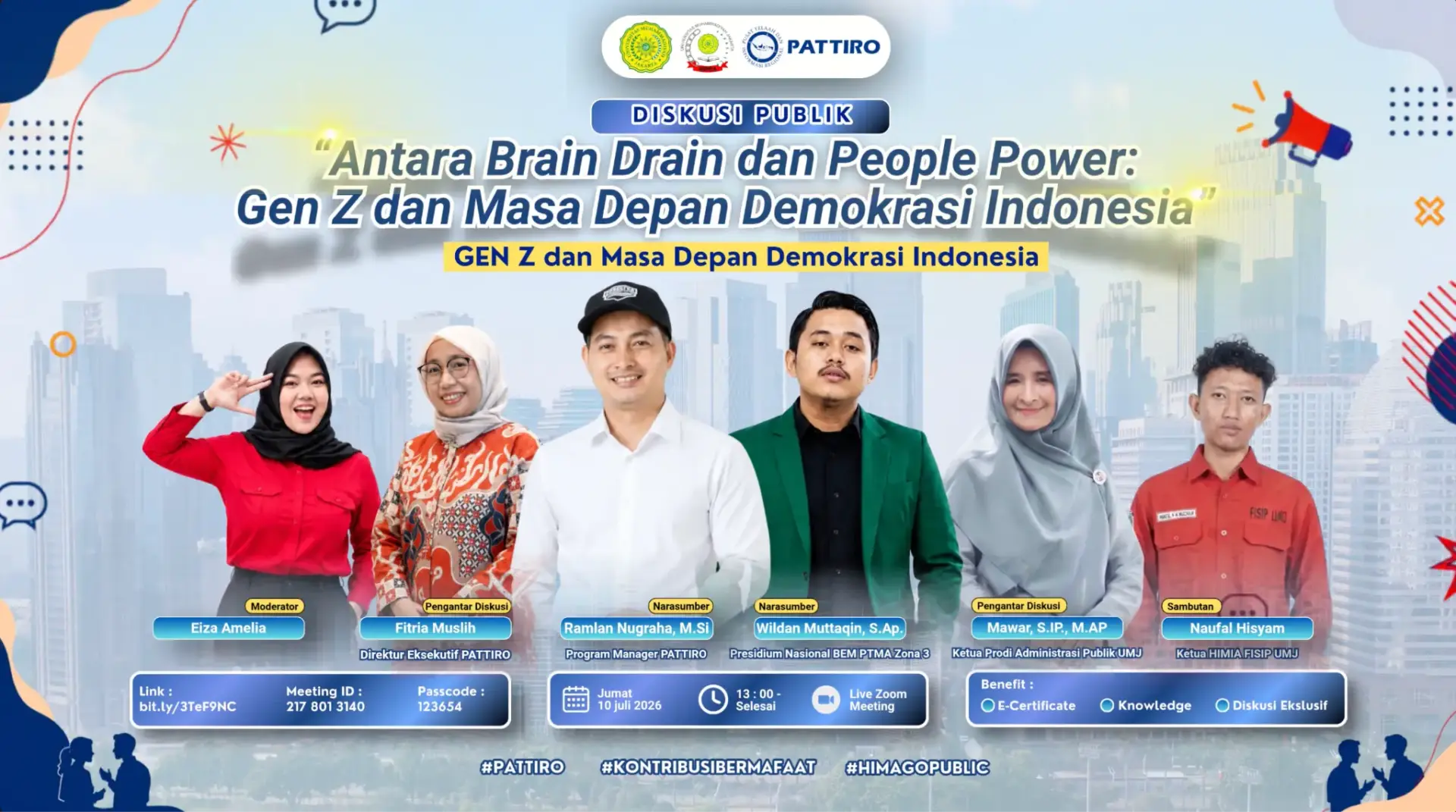
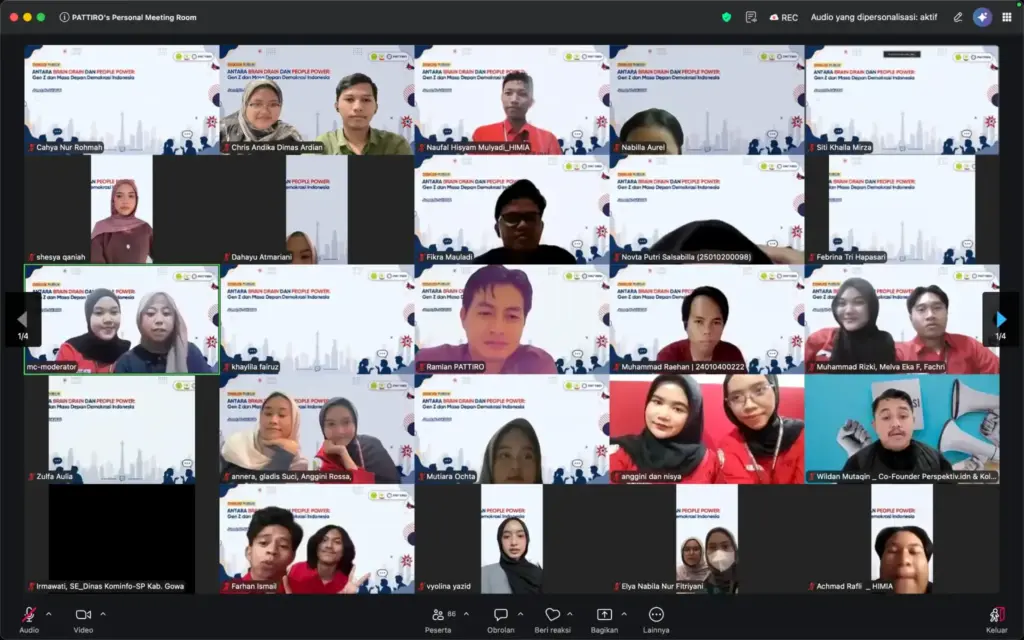
These issues came to the fore in a public discussion titled “Between Brain Drain and People Power: Gen Z and the Future of Indonesian Democracy”, organized by PATTIRO in collaboration with the Public Administration Student Association (HMIAP) of the Faculty of Social and Political Sciences (FISIP) at Universitas Muhammadiyah Jakarta, held online on Friday, 10 July 2026.
The forum featured PATTIRO Program Manager Ramlan Nugraha, M.Si., and Wildan Mutaqin, S.AP., National Presidium of BEM PTMA Zone 3. The discussion brought together students, academics, and civil society to examine the relationship between talent mobility, state capacity, and youth participation in safeguarding democracy.
Brain Drain and the Challenge to Democratic Capacity
Brain drain should not simply be equated with a decline in nationalism. Young people’s decisions to work or study abroad often stem from rational considerations, such as income, research facilities, career advancement, academic freedom, and recognition of competence.
PATTIRO Executive Director Fitria Muslih emphasized that such choices should not be judged as a form of disloyalty to Indonesia. She argued that the real question to examine is the state’s ability to provide an environment that supports young talent.
“We are not debating whether young people who choose to work abroad are nationalist or not. The more fundamental question is whether Indonesia is a promising enough place for young talent to grow, contribute, and become part of change,” said Fitria.
Fitria also noted that many students and young people already have the capacity and creativity to engage in policy change. However, that capacity needs adequate support.
“Young people have real abilities and a strategic role to play. The question is whether the state has provided the support needed for that capacity to grow,” she said.
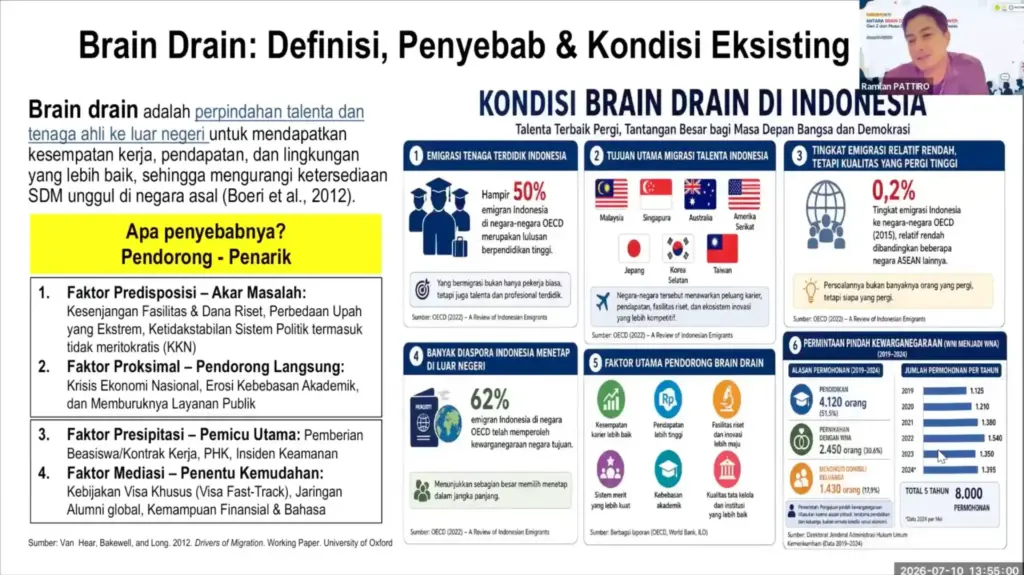
Ramlan Nugraha explained that brain drain refers to the movement of talent and skilled workers abroad in search of better job opportunities, income, and living conditions. According to the material he presented, nearly 50% of Indonesian emigrants in OECD countries are university graduates. While Indonesia’s overall emigration rate is relatively low, the real issue lies in the quality of the human resources who leave.
“The issue isn’t just how many people leave, but who leaves. When those leaving Indonesia are educated professionals, the state loses not just labor, but capacity,” said Ramlan.
According to Ramlan, brain drain is not driven by wage gaps alone. Disparities in research facilities and funding, academic freedom, and declining public services can also push talent to seek opportunities abroad. Meanwhile, scholarships, employment contracts, global alumni networks, language skills, and easier visa access act as factors that accelerate this movement.
Brain drain does not automatically cause democratic decline. However, the loss of educated workers can reduce state administrative capacity, innovation, service quality, and the ability to produce evidence-based policy. In his presentation, Ramlan Nugraha also noted that Indonesian democracy still falls into the category of flawed democracy, with its main challenges lying in political culture, civil liberties, and government effectiveness.
“Brain drain doesn’t directly weaken democracy. But when public institutions lose top talent, their capacity shrinks, the quality of policymaking declines, and public trust in institutions weakens too,” said Ramlan.
Wildan Mutaqin expanded on the issue, explaining that the threat to democracy comes not only from educated people leaving, but also from the apathy of those who remain in the country.
“Democracy doesn’t die because there aren’t smart people. Democracy dies when smart people choose to stay silent,” Wildan asserted.
Wildan pointed out that having degrees and competence is not enough for the educated class. Knowledge must be used to understand problems, hold power accountable, and generate benefit for society.
“Good people in this republic must not stay silent. They have to take on a role. We cannot let democracy be seized by those who do not stand with the people,” he said.
From Brain Drain to Brain Circulation
Banning or restricting people from working abroad is not the right solution to brain drain. Global mobility can instead become a strength if the state is able to maintain its connection with Indonesian talent and provide space for them to keep contributing.
Ramlan proposed a brain circulation approach — a process in which professionals, scientists, researchers, and entrepreneurs working abroad maintain ties with their home country through the exchange of knowledge, investment, technology, and business networks, as well as through temporary or permanent return.
“Talent may work abroad, but their knowledge, experience, networks, and investment must still flow back to their home country,” said Ramlan.
Such contributions can take the form of joint research, mentoring, teaching, technology transfer, startup development, investment, or facilitating international networks. In this way, talent based abroad is not entirely lost, but can become a bridge between Indonesia’s needs and global sources of knowledge.
“The solution isn’t to ban people from leaving. The solution is to build a democratic environment that makes talent want to return, or keep contributing even while abroad,” he said.
However, brain circulation cannot rest on the personal goodwill of the diaspora alone. The state needs to provide a credible merit system, research support, recognition of expertise gained abroad, and clear mechanisms for collaboration.
Fitria stressed that talent development policy also needs to directly involve young people.
“If we don’t involve them, we won’t know what they expect or what they want. We can’t keep using an older generation’s perspective to read young people’s needs,” she said.
Mawar, Head of the Public Administration Study Program at FISIP UMJ, likewise noted that universities hold an important position in building student capacity. Learning cannot rely solely on classroom theory, but needs to be strengthened with perspectives from civil society organizations, government, practitioners, and the business world.
“Student learning is not enough if confined to the classroom or built solely on theory from academics. They need to gain a range of perspectives from practitioners,” said Mawar.
Mawar also urged that the discussion not remain merely a ceremonial forum, but instead help bring about major change going forward.
“The ideas that emerge need to be discussed further, published, and formulated into recommendations for stakeholders so they can have a long-term impact,” she said.
Knowledge-Based People Power
The question of who will safeguard democracy cannot simply be answered by asking young people to stay in Indonesia. Democracy needs citizens who are active, knowledgeable, organized, and willing to correct abuses of power.
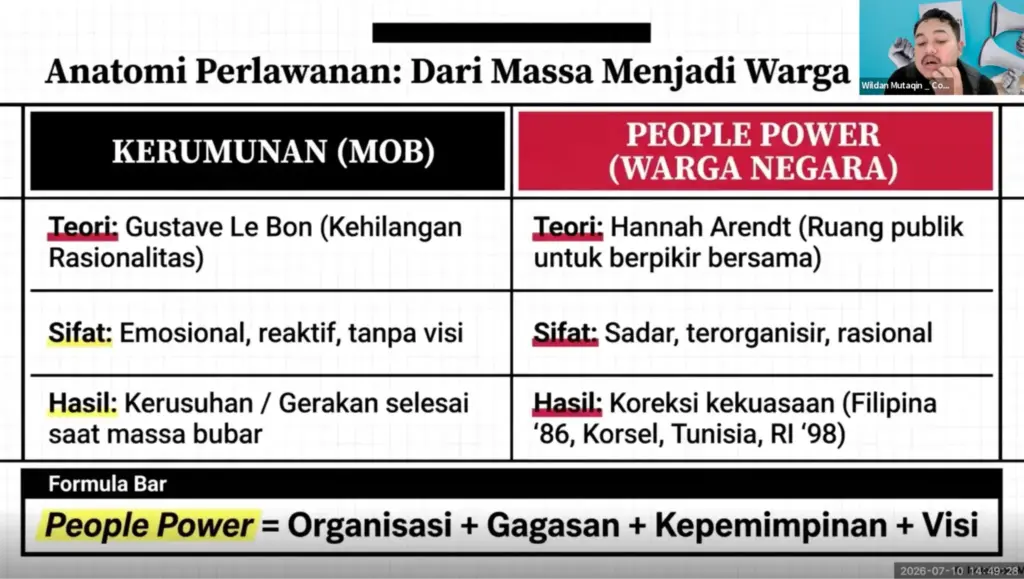
Wildan distinguished people power from a crowd driven purely by emotion. He argued that mobilization without ideas, organization, leadership, and purpose will simply stop once the crowd disperses.
“People power should be a space for citizens to think together — to become aware, organized, rational, and purposeful in correcting power,” said Wildan.
Wildan believes that demonstrations remain part of democracy, but are not enough to produce lasting change. Public movements need to be reinforced with data, research, policy briefs, draft legislation, and media and public education strategies.
“If a movement has knowledge, it stays alive. There are many paths we can take: writing, speaking, making podcasts, doing research, organizing, advocating, and educating,” he said.
Wildan also highlighted the poor quality of conversation in digital spaces. The ease of expressing an opinion is not always matched by the ability to read, verify information, and build a sound argument.
“What’s troubling is when literacy declines while the urge to comment rises. On social media, everyone can become a judge and criticize without any real argument,” he said.
For this reason, Gen Z’s technological skills need to be directed toward developing civic technology, monitoring budgets, expanding public education, and building knowledge-based participation.
This view aligns with Ramlan’s, who positions Gen Z as active citizens, guardians of governance, agents of digital innovation, drivers of brain circulation, and future leaders.
“Gen Z is not just the heir to democracy, but also its driving force. They need to safeguard transparency, accountability, and the use of the state and regional budgets, and become pioneers of digital innovation,” said Ramlan.
Strengthening Collaboration to Safeguard Democracy
This discussion shows that brain drain and people power are both tied to the ability of the state and society to provide space for young people to grow and contribute at the same time.
Brain drain becomes a problem when the state loses talent without having a mechanism to sustain their ties and contributions. But keeping educated people within the country is not enough either, if they are not given room to grow or choose to stay silent on public issues.
Democracy therefore needs to be strengthened through collaboration. The state must improve its merit system, research support, academic freedom, job opportunities, and space for participation. Universities need to revive a culture of reading, discussion, and research. Civil society organizations can connect knowledge with advocacy, while the diaspora needs to be given channels to share their experience, technology, and networks.
Wildan summed up the challenge with this question:
“The question isn’t whether Indonesia has a future, but whether our generation is willing to be part of that future?”
Through this forum, PATTIRO and Universitas Muhammadiyah Jakarta are pushing for youth engagement that goes beyond one-off discussions and mobilization. Knowledge needs to be turned into research, advocacy, innovation, and policy recommendations. When the state loses part of its talent, democracy can still be safeguarded if that talent — whether at home or abroad — remains connected to the public interest. But this requires a state that is open to criticism, values competence, and gives young people real space to help shape Indonesia’s future.