

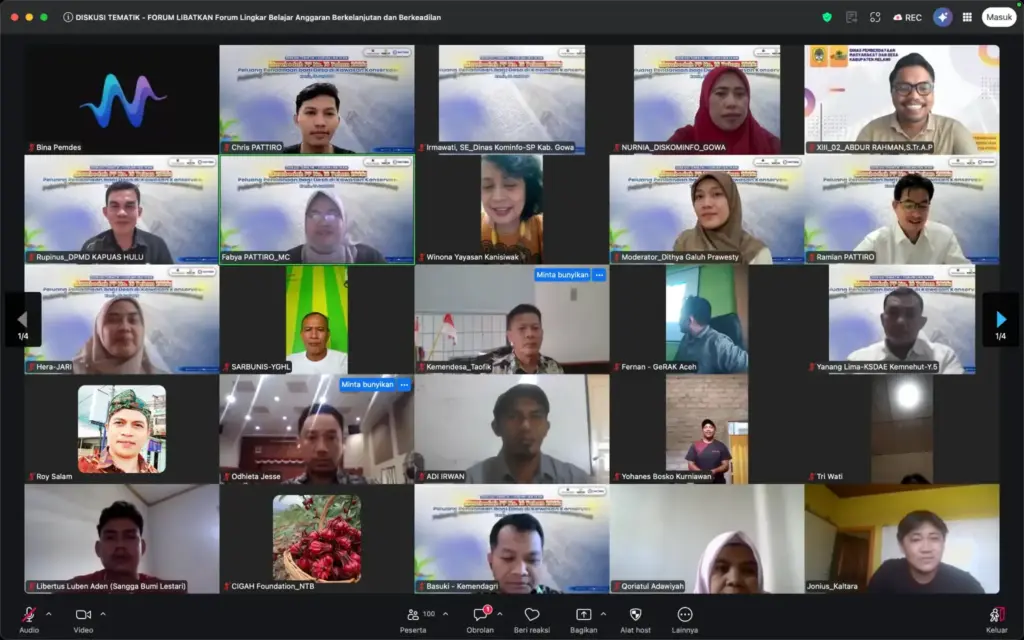
PATTIRO, together with the Civil Society Coalition for Ecological Funding (KMS-PE) and with support from The Asia Foundation, held a Forum Libatkan Thematic Discussion titled Funding Opportunities for Villages in Conservation Areas. The forum discussed opportunities for implementing conservation funds and rehabilitation funds as regulated under Government Regulation No. 16 of 2026.
The forum brought together perspectives from the central government, BPDLH (the Environmental Fund Management Agency), local governments, and civil society. The discussion affirmed that conservation funds should not be understood merely as environmental financing, but also as an instrument of fiscal justice for villages that have long safeguarded the ecological functions of these areas.
Conservation Funds as Recognition of Villages’ Role in Protecting Ecosystems
Conservation and rehabilitation funds need to be understood as a form of recognition for villages that have long protected conservation areas. Many village communities live around forests and depend on natural resources for their livelihoods, yet they also make a major contribution to preserving the environment.
Fitria Muslih, Executive Director of PATTIRO, emphasized that this policy is important because communities in conservation-area villages still face limited development and welfare.
“Conservation funds and village rehabilitation funds can serve as an instrument of fiscal justice as well as an incentive for villages and their communities to keep protecting the environment,” said Fitria.
That view was reinforced by PATTIRO Program Manager Ramlan Nugraha. He noted that conservation-area villages cannot be dismissed as insignificant, given their large numbers and major ecological role. At the same time, these villages face limited access, infrastructure, basic services, and welfare, as well as the potential for conflict.
“Conservation villages cannot be considered insignificant. Nearly 10 percent of villages in Indonesia are located within or around conservation areas. They make a major contribution, yet they also face challenges in development, access, infrastructure, basic services, welfare, and the potential for conflict,” explained Ramlan.
The regional perspective points to the same conclusion. Rupinus, Head of the Village Community Empowerment Office (PMD) of Kapuas Hulu Regency, stressed that communities in forest areas cannot simply be asked to protect nature without adequate economic support.
“We want communities in these areas to keep protecting the forest, but they also need to be able to live decently. We cannot let them protect the forest while receiving no support to improve their economy,” said Rupinus.
Indonesia has around 27.05 million hectares of conservation area. Within and around these areas lie 6,293 villages, or about 9.5 percent of all villages in Indonesia. As many as 2,288 villages have more than 50 percent of their territory within conservation areas, and 468 villages lie entirely within conservation areas. Conservation funding, therefore, cannot simply be seen as programmatic assistance. It needs to become a form of fiscal appreciation for the villages and communities that protect forests, biodiversity, and the ecological functions of these areas.
The Conservation Funding Gap Calls for More Diverse Financing Sources
Indonesia’s conservation funding needs remain very large. N. Yanang Lima, Senior Functional Expert (Jafung Ahli Madya) at the Ministry of Forestry, explained that conservation funding needs are estimated at Rp118 trillion to Rp163 trillion. Meanwhile, conservation funding at the Directorate General of Natural Resources and Ecosystem Conservation (KSDAE) in 2025 was only around Rp1.5 trillion.
“Conservation requires funding of around Rp118 trillion to Rp163 trillion, while conservation funding at the Directorate General of KSDAE in 2025 was only around Rp1.5 trillion. There is a very wide funding gap,” Yanang explained.
As a result, conservation cannot rely on the state and regional budgets alone. Yanang explained that Law No. 32/2024 and Government Regulation No. 16/2026 open up space for other legitimate funding sources, including environmental funds, trust funds, corporate contributions, third-party partnerships, grants, donations, environmental services, benefit-sharing schemes, and sustainable investment.
“Trust funds are one source through which villages can access conservation funding. This mechanism is being developed so that conservation funding can become more transparent, accountable, and sustainable,” Yanang explained.
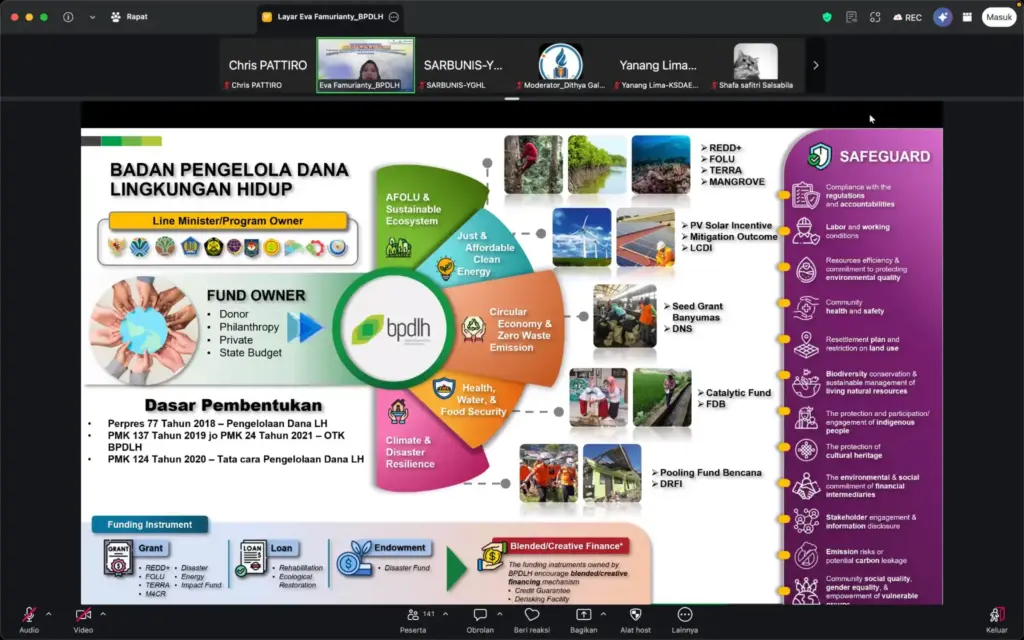
Eva Fahmuryanti of BPDLH explained that BPDLH has managed a range of environmental funding instruments, from grants and loans to endowment funds and blended finance schemes. These instruments are aimed at reducing greenhouse gas emissions, improving environmental quality, strengthening adaptive governance, and supporting sustainable community livelihoods.
“BPDLH supports Indonesia’s commitment to reducing greenhouse gas emissions and achieving sustainable development goals. Funding can come from domestic or international, public or private sources, and is channeled through various financial instruments,” Eva explained.
This shows that conservation funding needs a broader financing ecosystem. The state continues to play an important role, but other funding sources need to be strengthened so that conservation is not perpetually dependent on limited public budgets.
Kapuas Hulu Shows Why Fair Compensation for Conservation Areas Matters
The experience of Kapuas Hulu Regency offers a clear picture of the dilemma facing conservation areas. Rupinus explained that Kapuas Hulu covers roughly 3,131,824.60 hectares, of which 55.50 percent is designated as national park and protected forest.
“Kapuas Hulu covers around 3.1 million hectares. Most of it is national park and protected forest. Only about 20 percent can be managed by the community,” Rupinus explained.
The presentation by the Head of the Kapuas Hulu PMD Office also noted that, of the regency’s 278 villages, 39 are linked to national parks, 144 to protected forest, 98 to production forest, 91 to limited production forest, and 25 to convertible production forest. This leaves communities with limited room to manage land.
Rupinus further added that this limited management space also affects local economic development. Agricultural and plantation land accounts for only about 21.69 percent of the total area, while much of the remaining land lies within zones that cannot be freely managed.
“If communities are asked to protect the forest, they also need help so their economy can grow. We must not let them protect the forest while receiving no support to live decently,” said Rupinus.
Ramlan Nugraha sees conditions like those in Kapuas Hulu as the reason conservation funding needs an affirmative approach. Villages where most of the territory lies within conservation areas should be prioritized, since they carry a heavier ecological burden and have far less room to manage their land than other villages.
“There needs to be affirmative treatment for customary (adat) villages and villages where most of the territory falls within conservation areas. A village that is 50 percent or even 100 percent within a conservation area is clearly not the same as other villages,” Ramlan explained.
Conservation funding, therefore, needs to serve as fair compensation—not only for the region, but also for communities whose living space and economic opportunities are constrained by the area’s conservation function.
Technical Regulations Must Guarantee Governance, Participation, and Community Involvement
The success of conservation funding depends heavily on technical regulations. Government Regulation 16/2026 has opened the door, but still requires more detailed elaboration. Several matters need clearer definition, including the criteria for recipient villages, the proposal mechanism, verification, village designation, the types of activities eligible for funding, and reporting and monitoring.
Ramlan emphasized that conservation funds should not be automatically given to every village located within or around a conservation area. Funding needs to be directed to villages that are genuinely carrying out conservation or rehabilitation activities.
“Not every village located within or directly bordering a conservation area automatically receives funding. It needs to be assessed whether that village is actually carrying out conservation or rehabilitation activities,” Ramlan explained.
Taufik Hidayat, discussant from the Ministry of Villages and Development of Disadvantaged Regions, stressed that villages need to be positioned as the primary subjects of conservation. Villages are not merely beneficiaries, but key actors in sustaining natural resources and biodiversity.
“Villages are not just beneficiaries of development, but also the primary subjects responsible for sustaining natural resources, ecosystems, and biodiversity,” said Taufik.
Ramlan also urged that village governments not only serve as fund recipients, but also act as an intermediary, or bridge, between funding sources and the communities carrying out conservation work. This is because conservation actors on the ground are often indigenous communities, community groups, women’s groups, forest farmer groups, and local communities.
“Most of the key actors in conservation are found within communities, community groups, and indigenous communities. That is why conservation funding needs to create space for communities to be more active, while village governments serve as the connecting link,” Ramlan explained.
Inclusivity is another important point to note. Technical regulations need to ensure the involvement of indigenous communities, women’s groups, vulnerable groups, and local communities from the planning, budgeting, and implementation stages through to monitoring. In this way, conservation funding becomes not just a government program, but a shared agenda with village communities.
Through this forum, PATTIRO put forward recommendations that should be addressed in the technical regulations governing the Conservation Fund and Rehabilitation Fund (DKDR) mechanism, namely
- Clarifying the criteria and scope of recipient villages, including customary (adat) villages, villages located within or around conservation areas, and coastal conservation villages.
- Strengthening the role of village governments as a bridge between funding sources and community groups implementing conservation at the field level.
- Clarifying funding sources and disbursement mechanisms, whether from the state budget (APBN), regional budget (APBD), BPDLH, other legitimate sources, or corporate support.
- Detailing the types of activities eligible for funding, such as community empowerment, forest and land rehabilitation, conservation of biological natural resources, and ecosystem restoration.
- Strengthening the institutional capacity of communities—including women’s groups, vulnerable groups, indigenous communities, and other local communities—so they can participate meaningfully.
- Ensuring that the DKDR becomes part of the village development agenda by involving the Ministry of Villages and Disadvantaged Regions (Kemendes PDT) and village facilitators, and by integrating it into Village Medium-Term Development Plans (RPJM Desa) and Village Annual Work Plans (RKP Desa).
With clear technical regulations in place, the DKDR is expected to become not only an instrument for protecting nature, but also a driver of fiscal justice and improved welfare for the villages that safeguard ecosystems within conservation areas.