The climate crisis and environmental degradation have increasingly underscored the vital role of local communities in safeguarding forests, coastal areas, and natural resources. Across various regions, communities stand at the forefront of climate change impacts — from coastal abrasion and environmental degradation to diminishing freshwater sources and escalating ecological disaster risks.
Amid these challenges, a range of community-based initiatives has emerged, seeking to build participatory environmental conservation. However, such efforts continue to face significant obstacles, including limited organizational capacity, technological constraints, administrative hurdles, and insufficient support for sustainable program development.
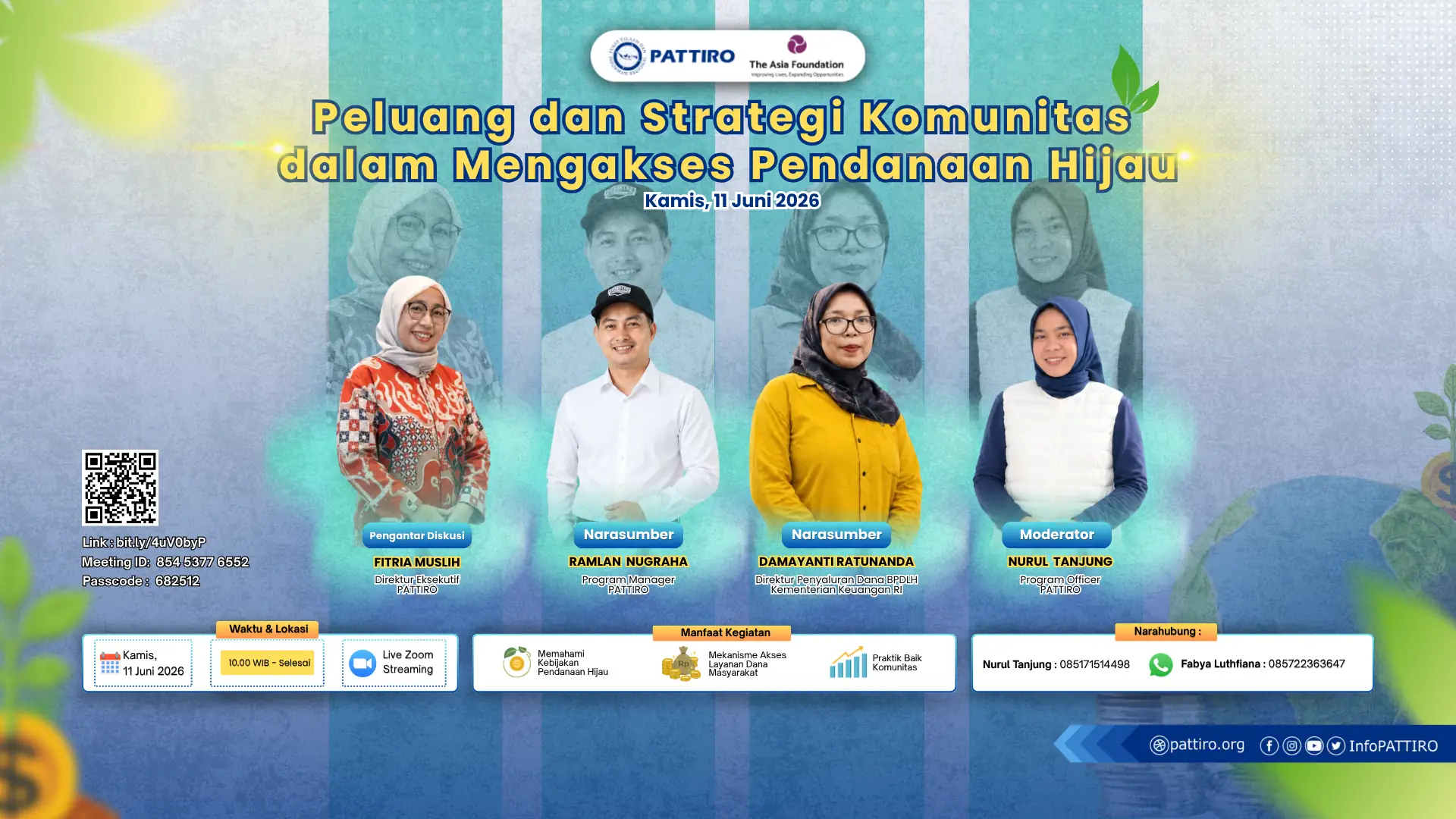
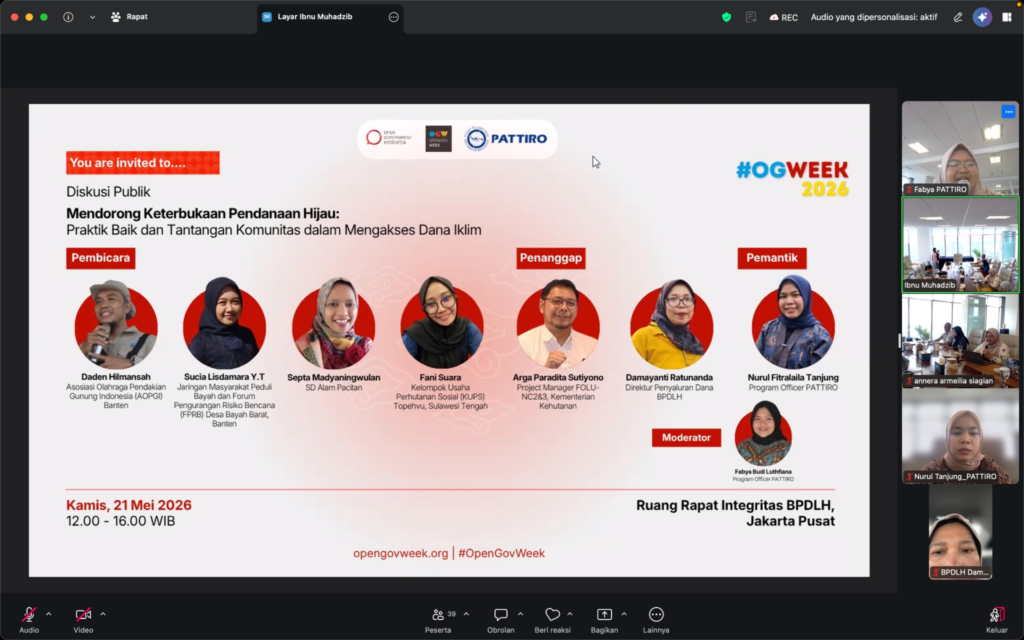
These issues came to the fore during a public discussion entitled “Promoting Transparency in Green Funding: Good Practices and Community Challenges in Accessing Climate Finance,” organized by PATTIRO as part of the OGI Week 2026 series, held on Wednesday at the BPDLH Office (21/05/2026).
In the discussion, PATTIRO Program Officer Nurul Fitralaila Tanjung delivered an introductory presentation on good practices in citizen-led initiatives grounded in local potential for accessing FOLU Small Grant Phase 4. To address administrative constraints and slow disbursement processes in the field, Nurul recommended that the government simplify reporting guidelines, align standards with actual regional price levels, and accelerate fund disbursement procedures.
To bridge communication between communities and the government, the forum brought together relevant government agencies to respond directly to community findings. Government representation was provided by Arga Paradita Sutiyono from the Ministry of Forestry and Damayanti Ratunanda from the Environmental Fund Management Agency (BPDLH).
Community Good Practices in Environmental Conservation
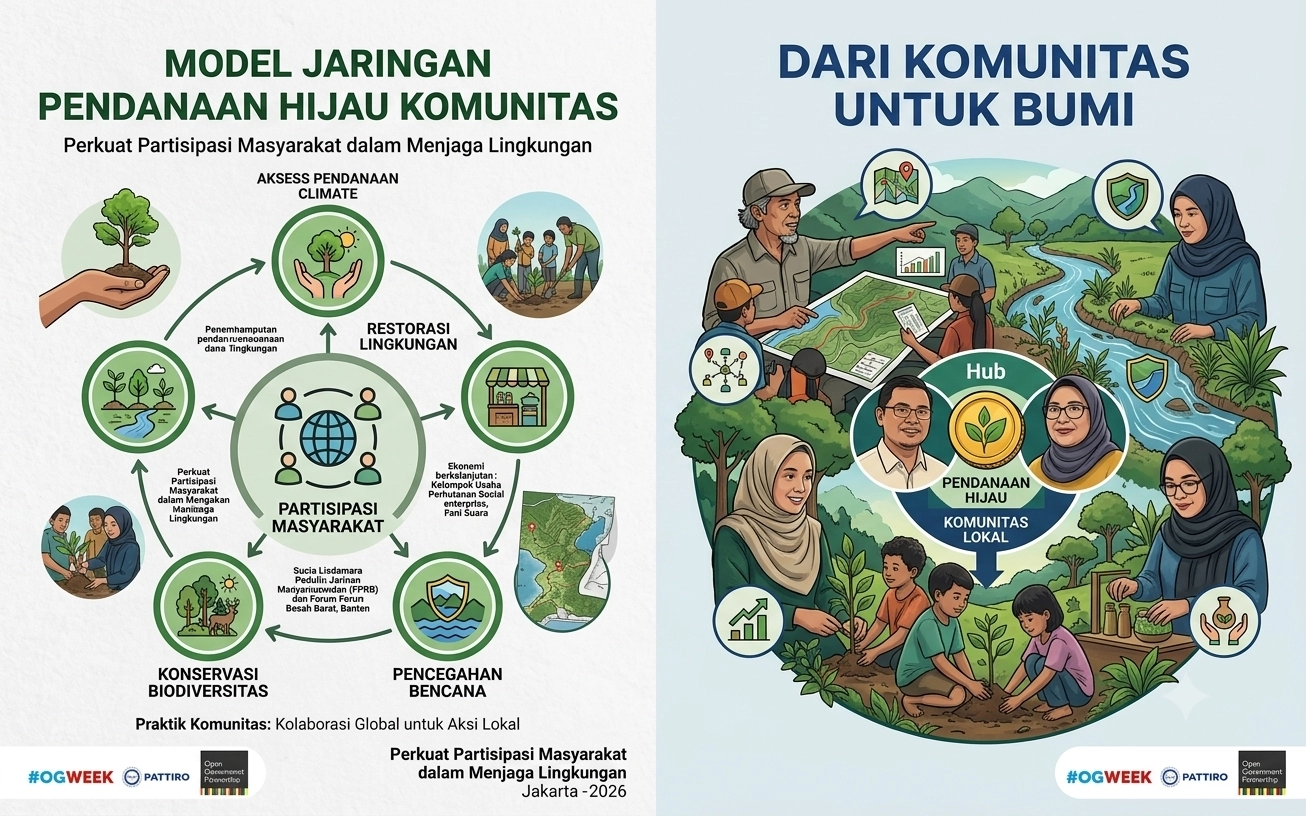
The forum brought together four communities that received FOLU Small Grant Phase 4: the Indonesian Mountain Climbing Sports Association (AOPGI) Banten; the Bayah Community Care Network (JMPB) and the Disaster Risk Reduction Forum (FPRB) of Bayah Barat Village, Banten; SD Alam Pacitan; and the Social Forestry Business Group (KUPS) Topehvu of Central Sulawesi.
The participants shared their experiences in developing community-based conservation through diverse approaches. In Central Sulawesi, KUPS Topehvu developed trigona honey management based on customary forests, focusing not only on forest preservation but also on strengthening the economic empowerment of indigenous women in the region. This approach demonstrates that environmental protection can advance hand in hand with community welfare.
Meanwhile, SD Alam Pacitan developed the Pesisir Asri Restorasi Alam Semesta (PARAS — Pristine Coast, Universal Nature Restoration) program, integrating environmental education with coastal restoration actions through mangrove planting and waste management education. The program encourages students to learn directly from their surroundings while building ecological awareness from an early age.
In Banten, AOPGI together with JMPB and FPRB of Bayah Barat Village developed various community-based environmental rehabilitation and disaster mitigation activities. These included river rehabilitation, water source protection, tree planting, and disaster education alongside conservation efforts in mountainous areas.
These good practices demonstrate that community-based environmental movements extend beyond conservation alone — they are also deeply connected to strengthening education, community economies, and building collective awareness of the importance of environmental sustainability.
Challenges in Developing Community-Based Environmental Programs
Despite their positive impacts on both environment and communities, the participating groups acknowledged ongoing challenges in program development and funding access. Limited administrative capacity, technological constraints, and lack of program management experience remain common barriers for community groups in the regions.
KUPS Topehvu representative Fani Saura disclosed that the group had initially faced difficulties in securing funding access. However, through mentoring provided by partner organizations, the group grew more confident in carrying out various environmental initiatives in their area.
“At first, we thought we were just a small group of indigenous women with many limitations. But the mentoring process made us believe that we, too, are capable of growing,” she said.
A similar view was shared by Septa Madyaningwulan of SD Alam Pacitan. In her experience, the process of accessing funding through the FOLU Small Grant went beyond proposal writing — it also served as a learning space for the school to strengthen program governance, build partnership networks, and ensure that program ideas genuinely addressed environmental needs at the grassroots level.
In this process, SD Alam Pacitan navigated several stages: understanding the program scheme, conducting internal team discussions, formulating proposal ideas and titles, analyzing field needs, and aligning the program with the school’s existing environmental education approach. PATTIRO’s mentoring assisted the school in understanding administrative aspects, strengthening program design, and building cross-community communication.
“For us, the challenge is not only about limited funding, but also about ensuring that the program is well-managed, involves many stakeholders, and continues after activities are completed. This funding has become a catalyst for mobilizing the participation of the school, parents, communities, and society in protecting the coastal environment,” said Septa.
SD Alam Pacitan’s experience illustrates that green funding support can serve as a vital entry point for educational communities to expand the scale of environmental action. Through the PARAS Pacitan program, the school not only conducts coastal restoration and environmental education, but also strengthens community collaboration in building more sustainable ecological awareness.
Furthermore, the communities agreed that cross-sector collaboration is a critical factor in sustaining community-based environmental programs. The involvement of local communities, government, civil society organizations, and youth groups is seen as essential to broadening the impact of these programs.
Strengthening Collaboration and Support for Communities
The communities’ experiences in accessing public service funding and their role in environmental stewardship were welcomed positively by the Ministry of Environment and BPDLH.
FOLU-NC2&3 Project Manager at the Ministry of Environment, Arga Paradita Sutiyono, responded positively to the community-level actions being carried out. According to Arga, community engagement is crucial to strengthening environmental action.
“Community involvement is a key factor in supporting environmental conservation efforts. Strengthening collaboration, mentoring, and community capacity development must be continuously pursued so that community-based environmental movements can grow more broadly and sustainably,” said Arga.
Through this discussion, PATTIRO hopes that the good practices of local communities can serve as shared learning to promote more collaborative and sustainable environmental management across regions — through accessible funding for grassroots communities. The experiences of these communities also demonstrate that society holds a strategic role in environmental stewardship while building social and economic resilience in the face of an intensifying climate crisis.