Waste management remains a serious challenge for many regions. The rising volume of waste generation has not been adequately matched by sufficient management systems — particularly in terms of source-based sorting, processing, and reducing the volume of waste reaching final disposal sites (TPA). This situation is further complicated by local governments facing budget constraints, inadequate infrastructure, limited institutional capacity, and low levels of community participation in waste sorting.
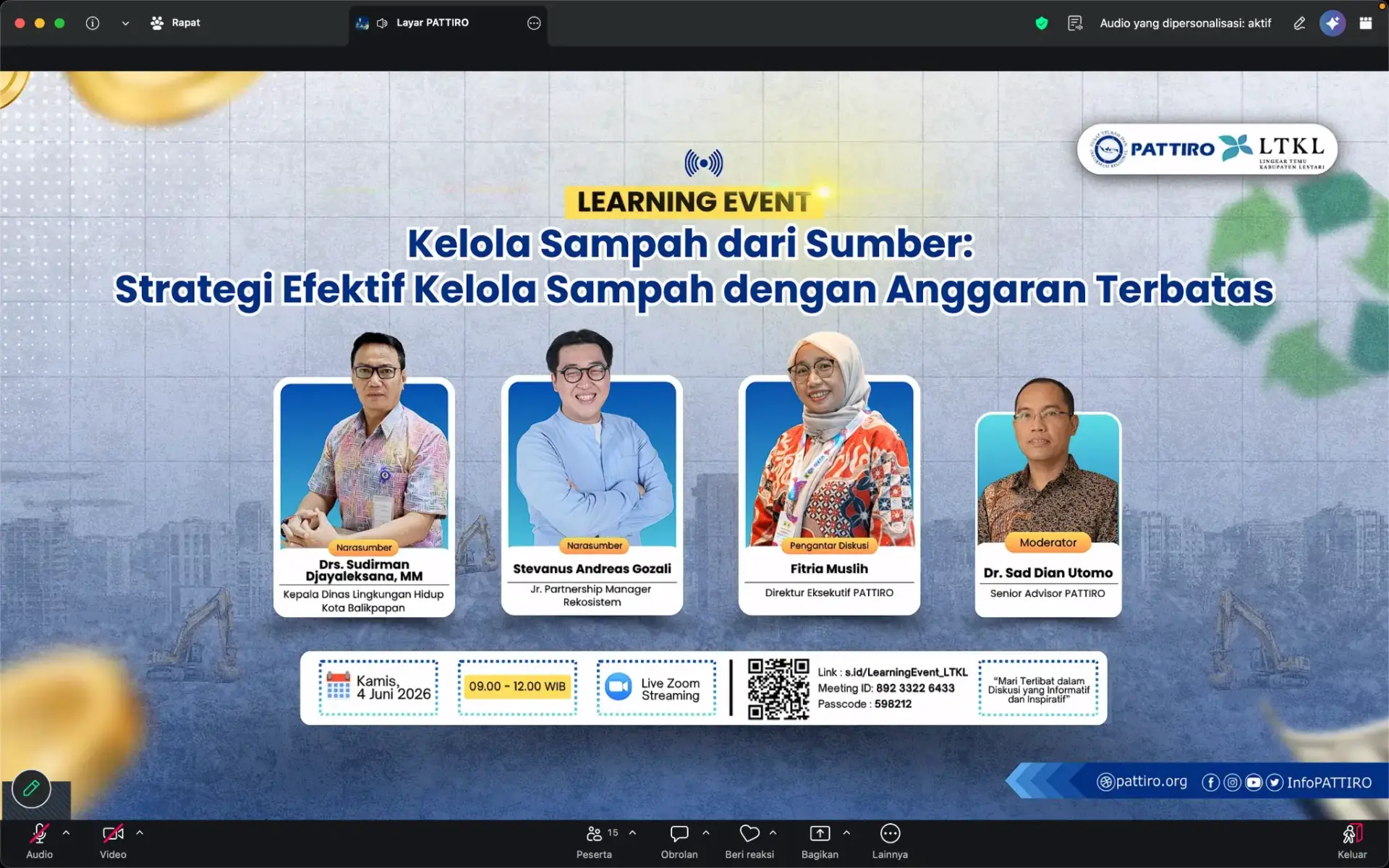
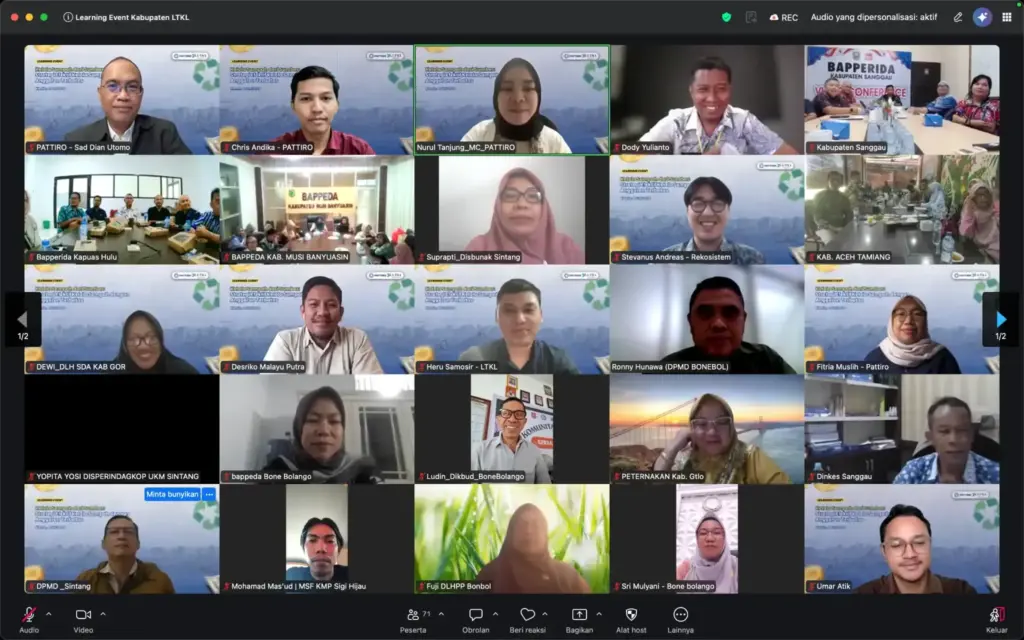
In response to these challenges, PATTIRO (Center for Regional Information and Studies) together with the Secretariat of Lingkar Temu Kabupaten Lestari (LTKL) organized an online Learning Event entitled “Managing Waste from the Source: Effective Waste Management Strategies on a Limited Budget” on Thursday, 4 June 2026. The forum served as a learning space for LTKL member district governments to explore good practices, strengthen collaboration, and identify more effective waste management strategies suited to regional capacities.
The event featured two main resource persons: Dodi Yulianto, Head of Waste and Hazardous Waste Management at the Balikpapan City Environment Agency and Acting Head of the Manggar Final Waste Processing Site (TPAS) Management Unit (UPTD); and Stefanus Andreas Gozali, Partnership Manager at Rekosistem. The discussion was facilitated by Nurul Tanjung, PATTIRO Program Officer, moderated by Sadian Utomo, PATTIRO Senior Advisor, and opened with introductory remarks by Fitria Muslih, PATTIRO Executive Director.
In the opening remarks, Desriko Malayu Putra, LTKL Membership Governance Manager, conveyed that waste is an issue also faced by LTKL member districts. According to Desriko, this forum was designed to create a cross-regional learning space so that regions can draw lessons from good practices already in place elsewhere.
“LTKL always seeks out various ideas and discussion topics that we can adopt and learn from other places, to then be applied in each of our respective districts,” said Desriko.
Desriko added that the lessons from Balikpapan City and Rekosistem are expected to serve as inspiration for other regions to adopt strategies suited to their local context through an observe, adopt, and adapt approach. This approach is important to ensure that good practices are not applied wholesale, but are adjusted to match each region’s fiscal capacity, institutional readiness, and social conditions.
In the introductory discussion, Fitria Muslih emphasized that waste management is not solely a technical matter for the Environment Agency. Drawing on PATTIRO’s experience in various regions, effective waste management requires the involvement of multiple regional agencies — including the Regional Development Planning Agency (Bappeda), Public Works Agency, Education Agency, Health Agency, Trade Agency, Cooperatives and SMEs Agency, Communications and Information Agency, and the Women’s Empowerment and Child Protection Agency.
“Waste management is not the sole responsibility of the Environment Agency and the Public Works Agency. All agencies can share roles based on their respective duties and functions,” said Fitria.
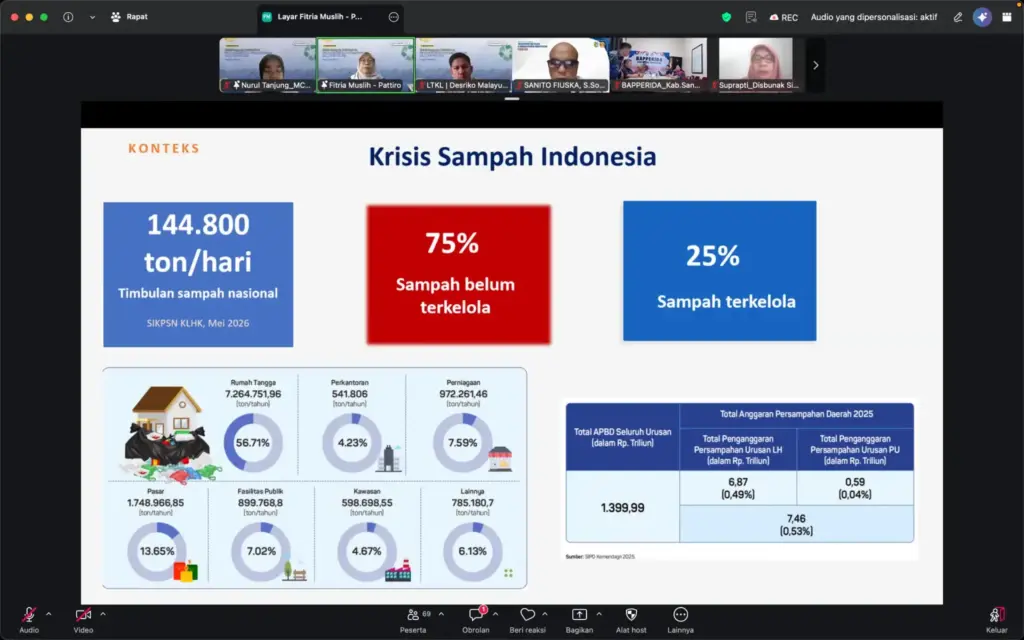
Fitria also highlighted the national waste crisis. Based on data presented at the forum, national waste generation exceeds 144,800 tonnes per day, while only approximately 25 percent is managed adequately. The majority of waste originates from households, making source-based sorting one of the key priorities in reforming the waste management system.
“The waste situation in Indonesia today is quite critical. Around 75 percent of waste is still not being managed properly,” Fitria explained.
According to Fitria, the prevailing “collect-transport-dispose” model must shift toward a “collect-transport-process-dispose” approach. Only residual waste should reach the final disposal site, while organic and inorganic waste must be sorted and managed at source. However, on-the-ground challenges remain significant — from low public awareness and collection systems that do not support sorting, to the many community-based waste processing facilities (TPS3R) that have yet to operate optimally.
Discussion moderator Sadian Utomo noted that this is a critical moment for waste management, as waste management reform has become part of the national strategic agenda. According to Sadian, the most effective solutions do not necessarily rely on expensive technology, but rather on sound governance and strengthening upstream systems.
“The most effective solutions are not always the most expensive. Source-based approaches, sorting, waste banks, composting, and circular economy models can all work effectively if managed in the right way,” said Sadian.
Leadership Commitment: The Key to Successful Waste Management
In the first session, Dodi Yulianto shared Balikpapan City’s experience in building a more integrated waste management system. Dodi emphasized that Balikpapan’s success rests not only on infrastructure, but also on commitment, regulation, financing, technology, and community participation.
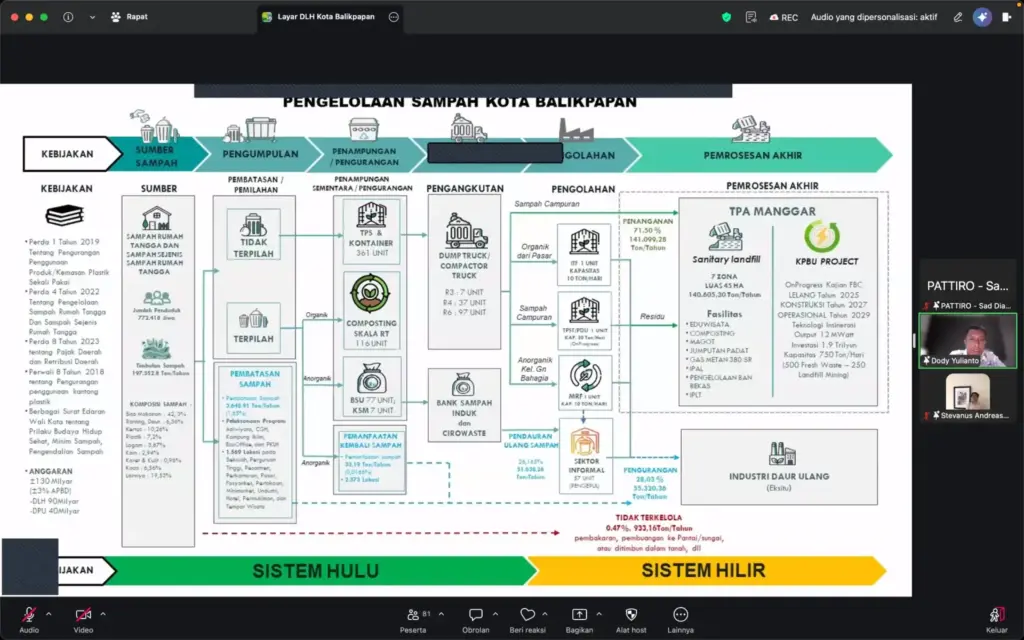
“There are five most important aspects of waste management: policy, institutional capacity, financing, technology and operations, and community participation,” said Dodi.
According to Dodi, the commitment of regional leadership is the primary foundation of effective waste management. In Balikpapan, the waste issue has been incorporated into the regional development direction, providing a stronger basis for technical planning and budgeting.
“In waste management, the most fundamental factor is commitment — both in technical planning and in budget planning,” Dodi explained.
On the financing side, Dodi explained that Balikpapan City’s waste management budget for 2026 reaches nearly IDR 80 billion, with an additional approximately IDR 14 billion for the Manggar TPAS management unit. Combined, the waste management budget amounts to approximately IDR 95 billion, or close to 3 percent of the regional budget (APBD). Nevertheless, retribution revenues have yet to fully cover management costs, meaning budget support and collaboration remain necessary. Balikpapan has also been driving behavioral change through the phased dismantling of temporary waste collection points (TPS), strengthening waste banks, and early environmental education.
“With the dismantling of temporary waste points, 75 waste transport businesses have emerged. Waste banks have also grown from around 75 to around 210,” Dodi explained.
On the downstream side, TPAS Manggar stands as an example of more modern waste management through a sanitary landfill system. The facility has seven zones and receives approximately 350 to 400 tonnes of waste per day. In addition to leachate treatment, composting, and maggot cultivation, TPAS Manggar also harnesses methane gas to supply the energy needs of surrounding households.
“We distribute the methane gas to residents through a pipeline network with 380 household connections. Residents pay a monthly contribution of IDR 10,000 for their cooking needs,” said Dodi.
Dodi emphasized that the transformation of Manggar from an open dumping system to a more modern management approach began with a series of foundational steps. The government closed temporary waste collection points and required communities to sort waste at source. However, this policy did not simply demand behavioral change from the public — the government also provided a range of supporting facilities and systems, including the development of waste banks, the provision of sorting infrastructure, and the consistent implementation of a sorted waste collection schedule. According to Dodi, the combination of firm policy and adequate infrastructure support was the key driver in shifting waste management patterns within the community.
Waste as a Commodity
In the following session, Stefanus Andreas Gozali from Rekosistem shared a perspective on technology-based waste management and the circular economy. According to Stefanus, the core problem in many regions stems from organic, inorganic, and residual waste being mixed together from the point of origin. As a result, materials that could be recycled become contaminated and end up as residual waste.
“At Rekosistem, we believe that waste is not only a problem — it is also a commodity,” said Stefanus.
Stefanus explained that this shift in perspective is essential for building a circular economy. Waste can become a new raw material if it is sorted, recorded, processed, and entered into the appropriate recycling chain. Rekosistem refers to this approach as urban mining — the effort to extract value from waste generated by communities.
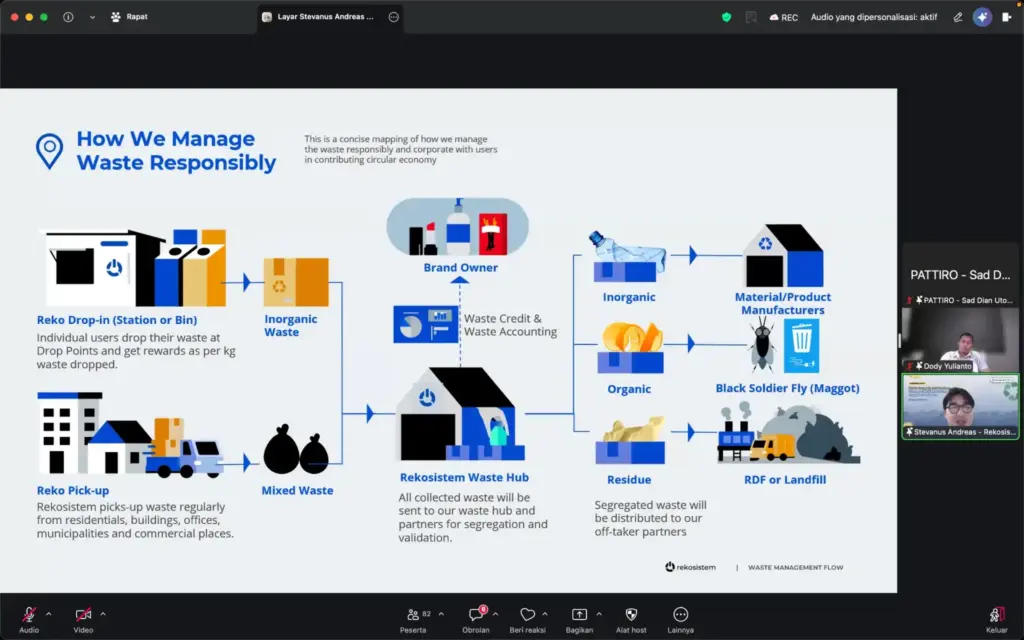
In practice, Rekosistem has developed a range of management channels, from waste stations, drop points, a digital application, and collection systems, to sorting, data recording, preprocessing, and distribution of materials to the recycling industry. Through the app, communities can deposit inorganic waste and earn points redeemable through e-wallets or banking services.
“To encourage people to sort waste, we give them recognition. Their daily effort to sort waste does not go unrewarded,” said Stefanus.
Rekosistem has also introduced a single stream recycling approach to make it easier for communities to sort inorganic waste — such as plastics, cardboard, glass, and metal — in a single container before depositing it at a waystation. According to Stefanus, the most realistic first step is ensuring that inorganic waste is already separated from organic and residual waste.
“The most important thing is that the inorganic waste is already sorted. That is a standard that communities can realistically achieve in the near term,” Stefanus explained.
During the discussion session, participants also raised questions about opportunities for regional collaboration with Rekosistem. Stefanus explained that collaboration could begin with the development of waystation points, integrated waste processing facility (TPST) management, waste data recording, sorting, and operational systems for non-hazardous waste management. Rekosistem has already implemented a TPST management model in Mojokerto and is exploring the development of waystation points in a number of cities.
Responding to the presentation, Sadian Utomo observed that one of the key messages from Rekosistem is the ability to transform waste into a valued commodity.
“Waste is a commodity — it can even become urban mining. Waste can be processed, generate economic value, and become useful products,” said Sadian.
This learning event affirmed that effective waste management under budget constraints remains achievable, provided that regions demonstrate commitment, sound planning, supportive regulation, cross-sector collaboration, and strategies that begin at source. Through this forum, PATTIRO and LTKL encouraged LTKL member districts to incorporate waste management as an integral part of their sustainable development agenda.