

Amid growing fiscal pressure, local governments are asking the central government for greater flexibility in managing their budgets. The Regional Secretary of Jeneponto Regency, Dr. Aspa Muji, S.STP., M.Si., urged that regions be given room to reallocate budgets from operational spending to capital spending and disaster mitigation without having to go through convoluted bureaucracy. He made the remarks at a Local Governance Forum (LGF) discussion organized by PATTIRO in September 2026, themed “Budget Imbalance and Inefficiency: Old Problems Still Unresolved.”
The forum featured several speakers: the Chair of the PATTIRO Board of Trustees and author of the book Membedah Ketimpangan Anggaran (Dissecting Budget Imbalance), Maya Rostanty; Wahyudi from the Directorate General of Fiscal Balance (DJPK) at the Ministry of Finance; two representatives of the Ministry of Home Affairs, namely Ernest Rakinaung, Head of the Subdirectorate for Technical Support for Transfer Facilitation and Regional Debt Financing, and Hilman Rosada, Junior Expert at the Directorate of Regional Budget Planning; as well as Dr. Aspa Muji, Regional Secretary of Jeneponto Regency.
The discussion was held to revisit the relevance of the findings of the book Membedah Ketimpangan Anggaran, published by PATTIRO in 2005. Two decades on, imbalances in the structure of regional budgets (APBD) remain a problem in the governance of local government. Regulations have indeed changed repeatedly, but regional spending patterns are still dominated by bureaucratic spending rather than spending that directly benefits the public.
Aspa Muji’s call for regions to be free to shift budgets away from operational items is in line with PATTIRO’s earlier findings. PATTIRO Executive Director Fitria Muslih considers that the main problem in regional budget management is not merely the limited amount, but where the budget places its priorities.
“Our problem is not only how large the available budget is, but where that budget is directed and who gains the most from public funds,” said Fitria at the forum.
According to Fitria, the findings of the book Membedah Ketimpangan Anggaran, published in 2005, remain relevant to current conditions. The study found that most regional budgets were consumed by bureaucratic operational needs rather than public services. Two decades later, this is the very pattern that regions such as Jeneponto now want to change.
The central government does not deny this picture. Wahyudi of the Directorate General of Fiscal Balance (DJPK) at the Ministry of Finance acknowledged that the structure of regional spending has indeed shifted over the past two decades, but that the shift has not been enough to address the imbalance.
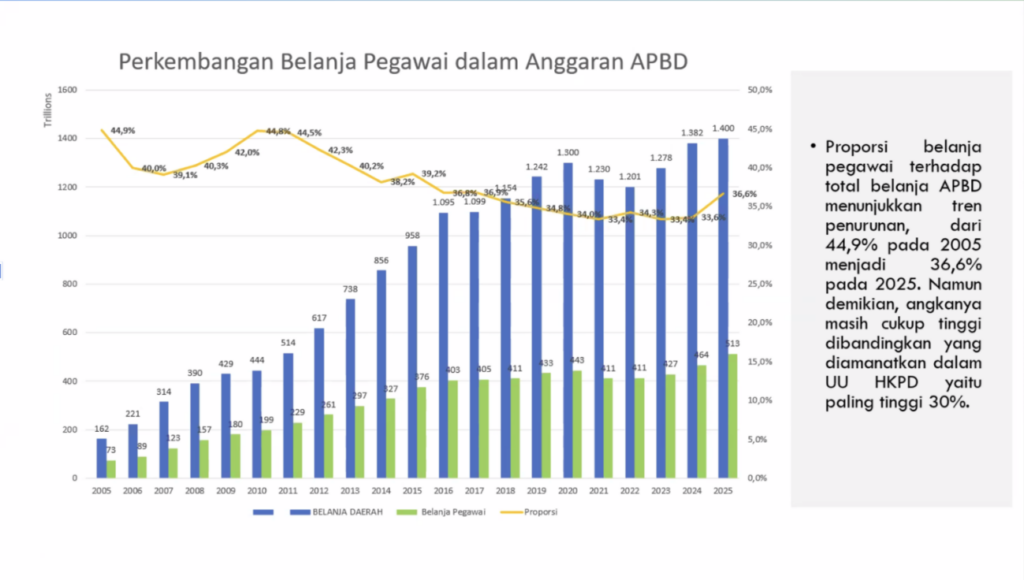
“Personnel spending has indeed declined from 44.9 percent to 36.3 percent. But this figure is still above the 30 percent maximum mandated by the HKPD Law (Law on Fiscal Relations between the Central and Regional Governments),” said Wahyudi.
On the other hand, capital expenditure, which should be the engine of development, fell by about 14.9 percent in 2025. For Wahyudi, this shows that the quality of regional spending remains a shared task to be addressed.
Budget Efficiency Must Not Lead to Cuts in Public Services
The issue of budget efficiency also emerged in the discussion. Through Presidential Instruction No. 1 of 2025, the government has urged regions to cut spending deemed to have no direct impact on the public, such as official travel, ceremonial activities, studies, publications, and other supporting expenditures.
The Ministry of Home Affairs stressed that such cuts must not stop at reducing numbers. Ernest Rakinaung reminded participants that efficiency must be directed toward improving the quality of spending.
“Efficiency is not simply about reducing the budget, but about making sure the available budget is truly directed toward achieving public service targets,” said Ernest.
The problem is that room to improve spending quality is shrinking because of the decline in Transfers to Regions (TKD). Data presented at the forum show that the 2026 TKD reduction pushed the average share of personnel spending up from 36.3 percent in 2025 to 41.4 percent in 2026. Regional revenue is shrinking, while personnel spending must still be paid. This is what makes regions’ demand for flexibility to reallocate budgets, as voiced by the Jeneponto Regional Secretary, increasingly urgent.
Limited fiscal space is not the only problem. The forum also highlighted the quality of the budget planning process, which is still considered weak. Maya Rostanty acknowledged that over the past two decades regional financial governance has made progress, from the use of the Regional Government Information System (SIPD), the application of Regional Unit Price Standards, and stronger evaluation of draft regional budgets (draft APBD), to the integration of regional financial data.
Even so, according to Maya, there are still three main outstanding tasks, namely: the quality of activity proposals, more substantive monitoring and evaluation, and public participation across the entire budget cycle.
“Many system improvements have been made, but the quality of planning at the activity level still needs to be strengthened so that every budget item has a clear purpose, indicators, and targets,” said Maya.
From Discussion to Recommendations
Based on these various issues, PATTIRO considers that budget imbalance cannot be resolved simply by changing regulations. Rule changes must be accompanied by better planning quality, stronger oversight, and public involvement in monitoring the use of public funds. Amid current fiscal pressure, PATTIRO also urges central and regional governments to strengthen collaboration so that efficiency policies do not end up eroding the quality of public services.
The forum underscored one key message: regional budgets must return to their basic purpose, which is to deliver the greatest possible benefit to the public. Efficiency should be a path to higher-quality spending, not merely cutting numbers.
As a follow-up, PATTIRO put forward recommendations covering two matters. First, encouraging a restructuring of regional spending so that the share of personnel spending gradually meets the 30 percent limit mandated by the HKPD Law, while giving regions the flexibility to reallocate operational budgets to capital spending and public services without convoluted procedures. Second, strengthening the obligation to prepare Terms of Reference (KAK) in budget planning, so that every activity has clear objectives and measurable indicators. Third, building collaboration with the central government to ensure fiscal policy gives regions room to improve the quality of their spending.