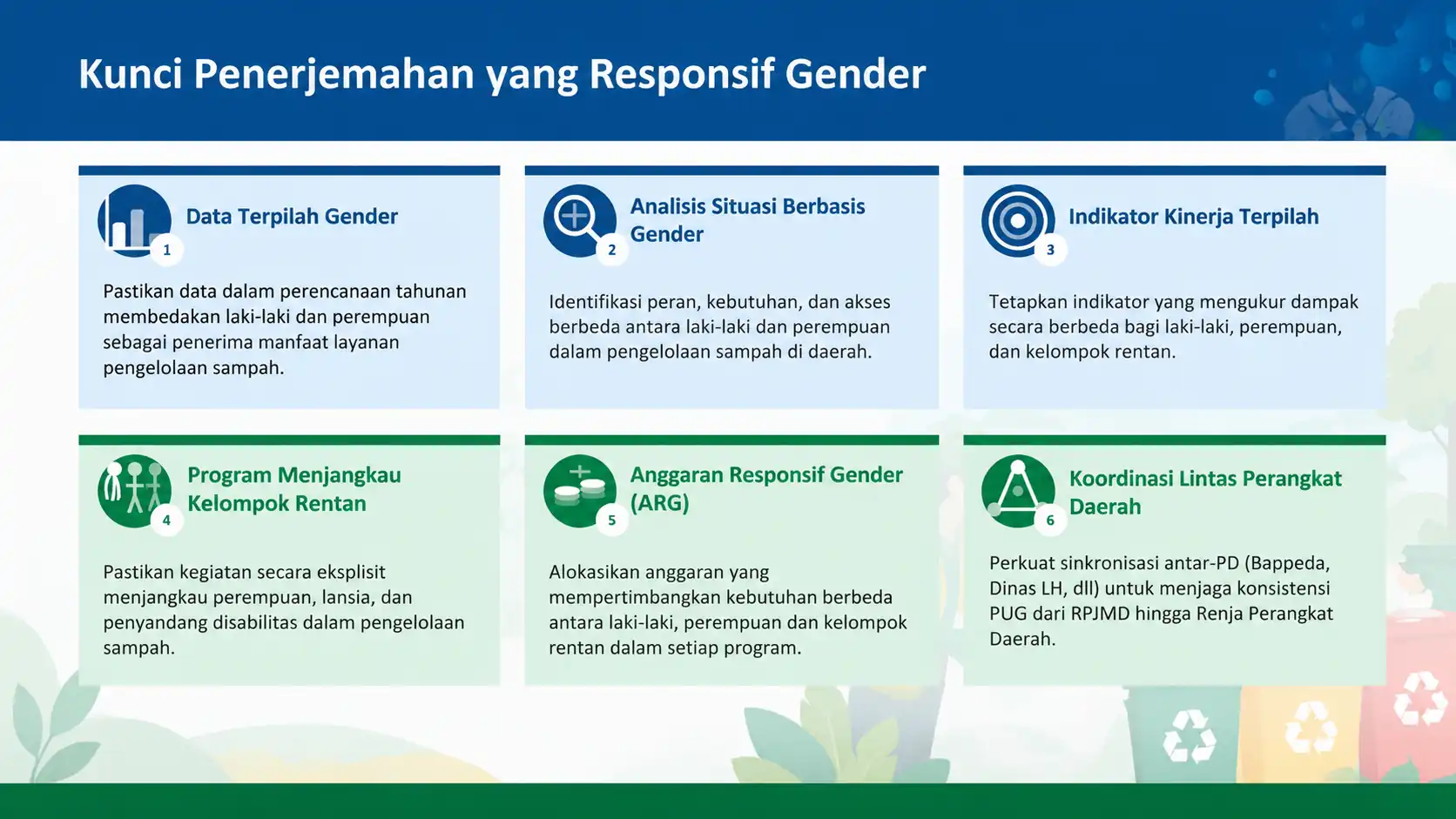
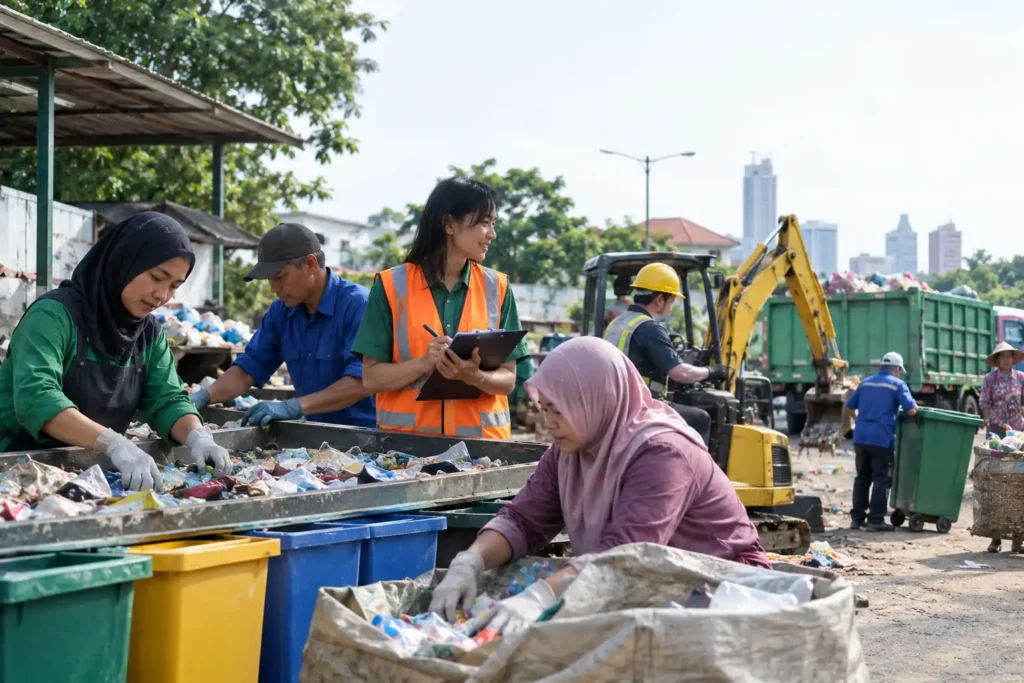
Integrating a gender perspective into regional planning documents is a first step toward inclusive development. However, the greatest challenge is not merely ensuring that gender issues are written into the RPJMD (Regional Medium-Term Development Plan) and Renstra (Strategic Plan), but how that commitment is translated into programs, indicators, budgets, implementation, and annual evaluations that respond to the needs of women, men, and vulnerable groups.
This was the main topic of the Focus Group Discussion (FGD) titled “Implementing the Commitment to Gender-Responsive Waste Management in the RPJMD into Annual Regional Planning,” held online by PATTIRO. The forum featured Acting Head of the Banyumas Regency Environment Agency (DLH) Dr. Arif Sugiono and Head of the Program Planning Subdivision at the Batam City DLH Raja Ahmadi, and involved ministries, agencies, and local governments in discussing how to strengthen gender-responsive waste management in regional development.
Gender Commitments Must Not Stop at Documents
PATTIRO Executive Director Fitria Muslih stressed that including gender issues in the RPJMD and Renstra is only the initial foundation. The next stage is ensuring that the commitment is applied in annual planning and budgeting.
“The commitments already written into the RPJMD and Renstra need to be translated into annual planning,” said Fitria.
Diah Mardhotillah made a similar point, emphasizing the importance of disaggregated data and improved planner capacity. In her view, applying a gender perspective requires information that can show gaps between women and men as a basis for designing programs. In addition, planners’ technical capacity and coordination across regional agencies still need to be strengthened.
Raja Ahmadi of the Batam City DLH added that Gender Mainstreaming (PUG) must be part of the entire development cycle, not merely an additional document.
“PUG is not an additional document, but must be part of the cycle from planning through to evaluation. The Renstra must be translated into the Renja (Annual Work Plan), analyzed through the GAP (Gender Analysis Pathway), GBS (Gender Budget Statement), and KAK (Terms of Reference), then linked to the RKA/APBD (Work Plan and Budget/Regional Budget) and demonstrated through monitoring and evaluation.” explained Raja.
This view shows that the success of gender-responsive waste management is measured not merely by whether gender issues appear in planning documents, but by the extent to which that commitment is applied in programs, indicators, budgeting, and the evaluation of regional development.
Disaggregated Data Reveals Hidden Gaps
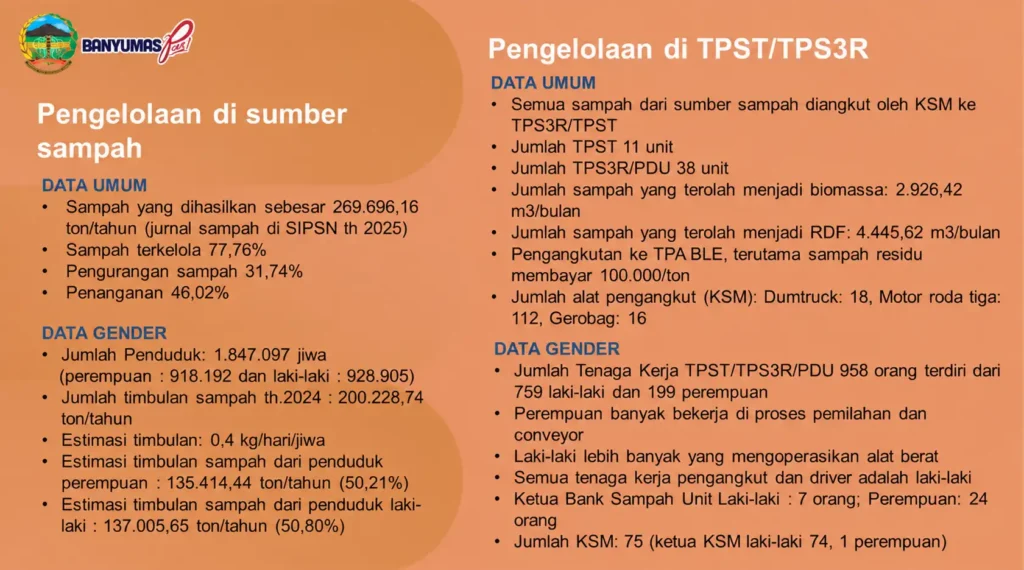
Banyumas Regency’s experience shows that women and men still have different roles in the waste management chain. Of the 958 workers at waste processing facilities (TPST, TPS3R, and PDU), 759 are men and 199 are women. Women are more involved in sorting activities, while technical work such as operating heavy equipment and transport is mostly carried out by men.
Dr. Arif Sugiono explained that this situation needs to be viewed through a gender lens.
“Women work mostly in the sorting process and on the conveyor. Men more often operate heavy equipment, and all of the transport workers and drivers are men.” said Arif.
These data show that women’s participation in waste management needs to be examined more deeply — not only counting how many are involved, but also looking at whether women have access to resources, opportunities to make decisions, economic benefits, and control over the activities being carried out.
Budgeting is a crucial stage for ensuring that the results of gender analysis are actually applied in programs. However, the size of a budget does not necessarily indicate that an activity is gender-responsive.
Raja Ahmadi explained that the key point in gender-responsive budgeting is its link to the problems and needs identified through gender analysis.
“A large budget does not automatically mean it is gender-responsive. What matters more is whether the budget is linked to the results of gender analysis and to indicators showing who gains access, participates, and benefits.” said Raja.
Thus, gender-responsive budgeting is not simply about attaching a gender label to an activity, but ensuring a clear link between the problem, the target group, the intervention, success indicators, and the budget allocation.
Every Region Needs a Different Strategy
The discussion also showed that approaches to gender-responsive waste management cannot be applied uniformly, because every region faces different challenges.
Brebes Regency, for example, faces the challenge of low male involvement in household waste management. The local government then partnered with religious leaders to raise public awareness.
“To increase men’s participation in household-level waste management, we partnered with ulama and religious leaders through a collection of Friday sermons on the environment.”
Meanwhile, Makassar City links waste management issues to the empowerment of vulnerable groups. Siti Saleha of the Women’s Empowerment and Child Protection Office explained that women heads of poor households are among the target groups. Education on waste sorting is expected to provide benefits while also boosting community incomes.
Through this forum, PATTIRO urges that gender integration in waste management not stop at the RPJMD, Renstra, and budgeting documents, but be translated into more inclusive programs and services. Such strengthening requires consistent use of disaggregated data, indicators capable of measuring access, participation, control, and benefits, improved planner capacity, stronger gender-responsive budgeting, and coordination among regional agencies. With more targeted implementation and clear evaluation mechanisms, gender-responsive waste management is expected to deliver not just administrative documents, but real change for women, men, and vulnerable groups.