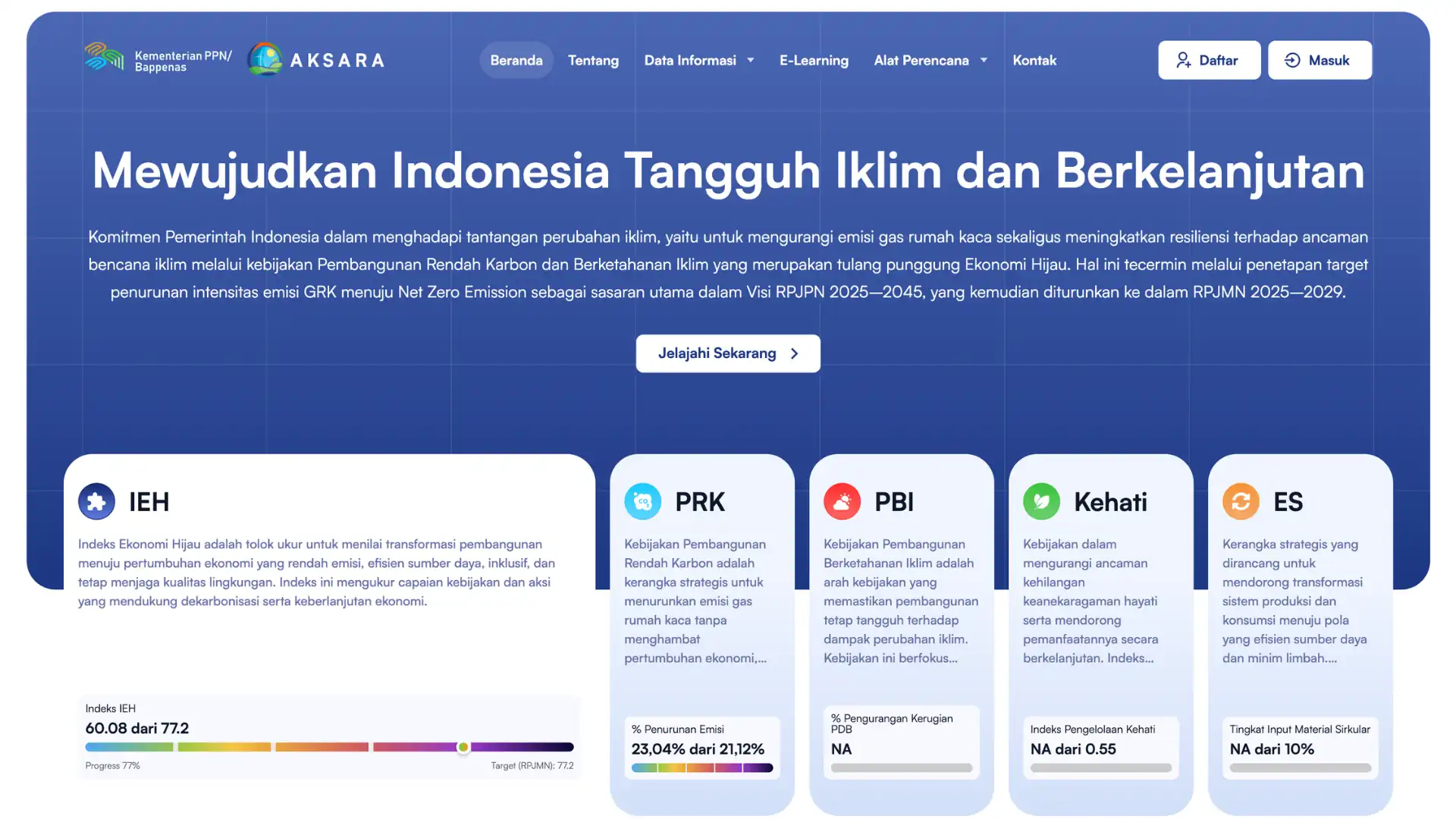
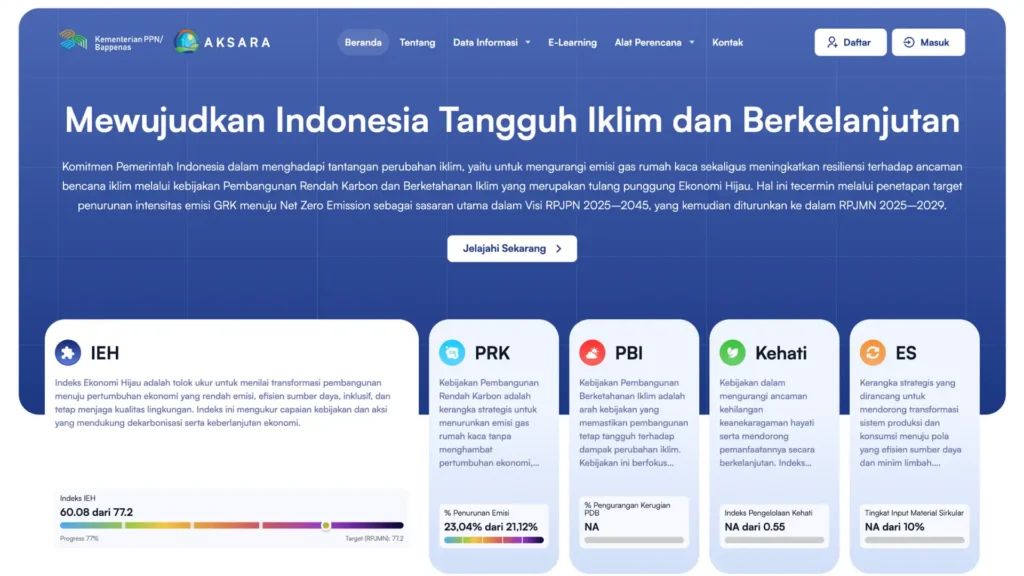
Data availability does not always mean the public has sufficient information. In low-carbon and climate-resilient development, Indonesia already has AKSARA, a platform developed by the Ministry of National Development Planning/Bappenas to support the planning, monitoring, reporting, and evaluation of climate action. Since its launch in 2019, AKSARA’s scope has continued to expand to cover the circular economy, biodiversity, and the green economy.
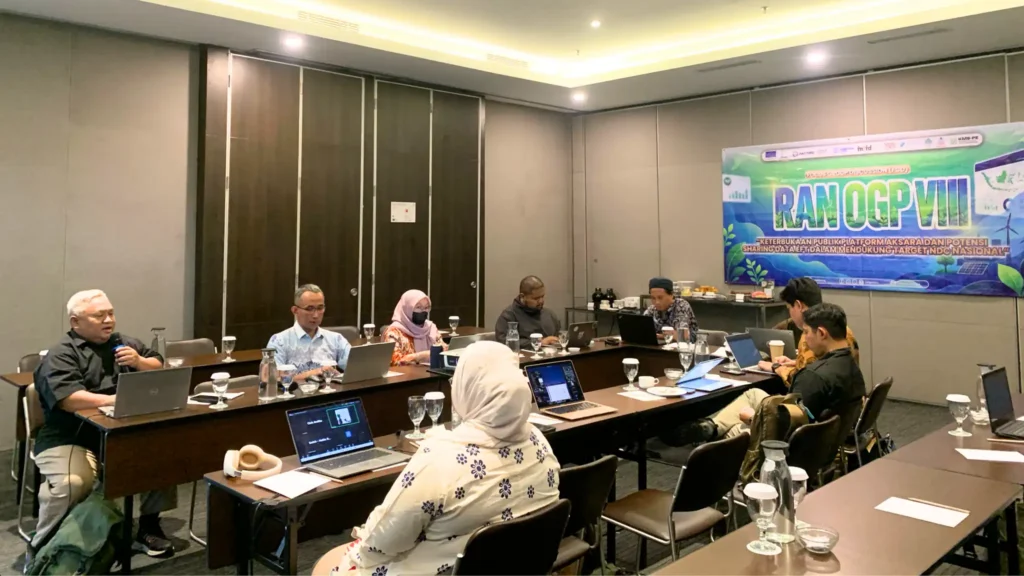
On the other hand, civil society is promoting Ecological Fiscal Transfer (EFT) as a fiscal incentive based on ecological performance. The challenge lies not only in the availability of AKSARA and EFT data, but in the extent to which that information is open and usable by the public to monitor the achievement of the Nationally Determined Contribution (NDC). This was discussed at the RAN OGP VIII FGD (Indonesia’s Open Government Partnership National Action Plan), “Public Openness of the AKSARA Platform and the Potential of EFT Data Sharing in Supporting the National NDC Targets,” organized by PATTIRO on 31 August 2026 together with Bappenas, The Reform Initiatives, and civil society organizations.
Openness Is Not Enough If Data Is Merely Available
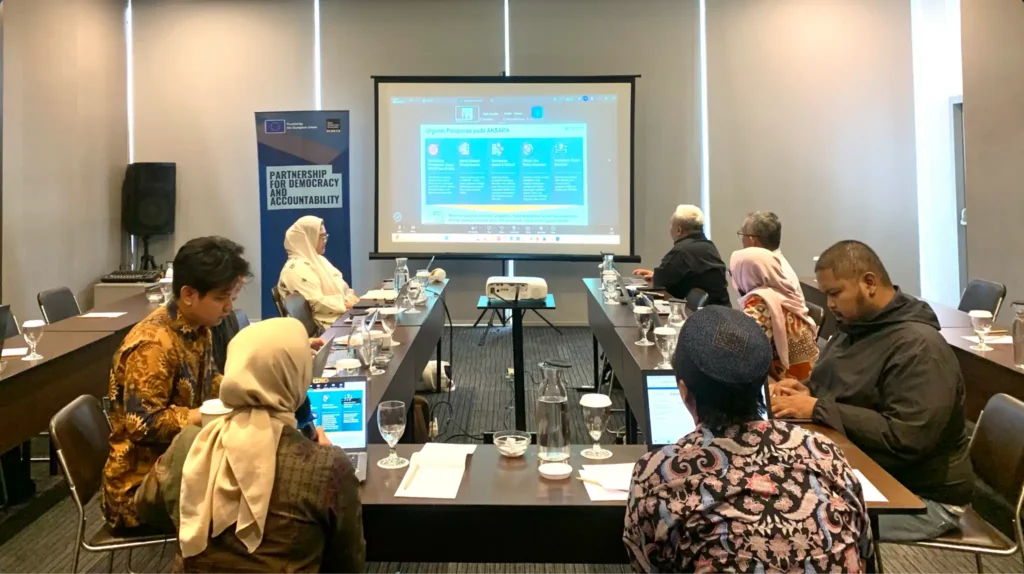
PATTIRO Executive Director Fitria Muslih placed AKSARA’s openness within the principle of Open Government. In her view, data should not remain solely in the hands of the government, but should also open space for civil society participation.
“We hope the data presented in AKSARA is in line with Open Government principles: openness, public participation, and accountability in governance. The hope is that data is not held only by the government, but that CSOs can also take part in sharing data,” said Fitria.
According to Rokhmad of YAPPIKA-ActionAid, AKSARA can be developed into a space of accountability between government and society. Information on what the government and non-state actors are doing should be usable for subsequent needs, such as monitoring and advocacy. Novia Mustikasari responded that questions about user needs are in fact important input for Bappenas.
“What level of information openness does the public need? The data and information exist, but can they be accessed? What do we need to open to the public in the AKSARA application, and to what extent should access categories apply?” said Novia.
Public access to data means not only being able to view information, but also being able to download, use, and reprocess that data. In AKSARA, the involvement of Non-State Actors such as the private sector, NGOs, and CSOs enables contributions of data on location, activities, and climate action funding.
Beyond open access, data quality and specifications are also a concern, so that green financing information does not merely repeat expenditure data already available on other government platforms.
“If we’re talking about spending, there are plenty of other applications and websites. So it has to be specific, for instance green financing. But not just the lump-sum figure. What are the details? If it’s the same as what can be accessed on the Ministry of Finance website, it will be redundant,” said Rokhmad.
EFT and the Challenge of Financing the NDC
Large climate financing needs demand strong openness and funding governance. Achmad Taufik, Deputy Director of The Reform Initiatives, stated that the financing needs of the Enhanced NDC are estimated at US$285 billion, while the Second NDC for the 2031–2035 period requires around US$472.6 billion.
These large needs pose a challenge amid limited regional fiscal capacity. Around 375 regions still have locally generated revenue (PAD) below 20 percent and therefore depend on central transfers, which can affect their ability to fund low-carbon development and environmental protection.
“On one hand, regions are being pushed to deliver public services related to low-carbon and climate-resilient development. On the other hand, regions must meet various mandatory spending requirements. When transfers decline, matters related to environmental protection are affected too,” explained Achmad.
AKSARA can help fill this gap because its data structure can record location, or geo-tagging, the type of activity, and more detailed technical information. In addition, EFT is linked to the NDC when incentives are directed toward forest protection, preventing deforestation and forest and land fires, waste management, and other environmental investments.
AKSARA and EFT Data Sharing Must Not Add Duplication
In the discussion session, Oke Indrayana of Perkumpulan Pilar Nusantara (PINUS Indonesia) asked how AKSARA and EFT data could practically be brought together. In his view, AKSARA’s structure is far more detailed, while Indonesia’s EFT has so far mostly recorded supporting documents, budget allocations, and EFT implementation.
“Looking at AKSARA, a great deal of information is entered. Meanwhile, EFT is still collecting supporting documents, the amount of money allocated by provincial, district, city, and village governments, and EFT implementation. When the time comes to merge them, what will the model look like?” asked Oke.
On data exchange, Novia stressed that EFT indicators need to be sorted so that the information displayed in AKSARA remains relevant to climate change issues. This approach is in line with the development of AKSARA’s interoperability through data sharing with various systems to avoid repeated data entry.
“The information the public needs to know includes the amount and source of funding, the criteria, the realization of achievements and funding, and most importantly the impact or results produced. Activities need not only to meet targets, but to show how they change the surrounding environment,” said Novia.
At the close of the forum, Fitria urged that discussions on EFT data sharing be continued with the Civil Society Coalition for Ecological Funding (KMS-PE). An inventory is needed to determine what data can be shared and what AKSARA information should be pushed to become more open.
“We need to take inventory of what data we can share. Some data turns out to still be in the backend and has not yet reached the front end. We might be able to propose this so that public information openness in AKSARA can truly be used by civil society to help support the national NDC targets,” said Fitria.
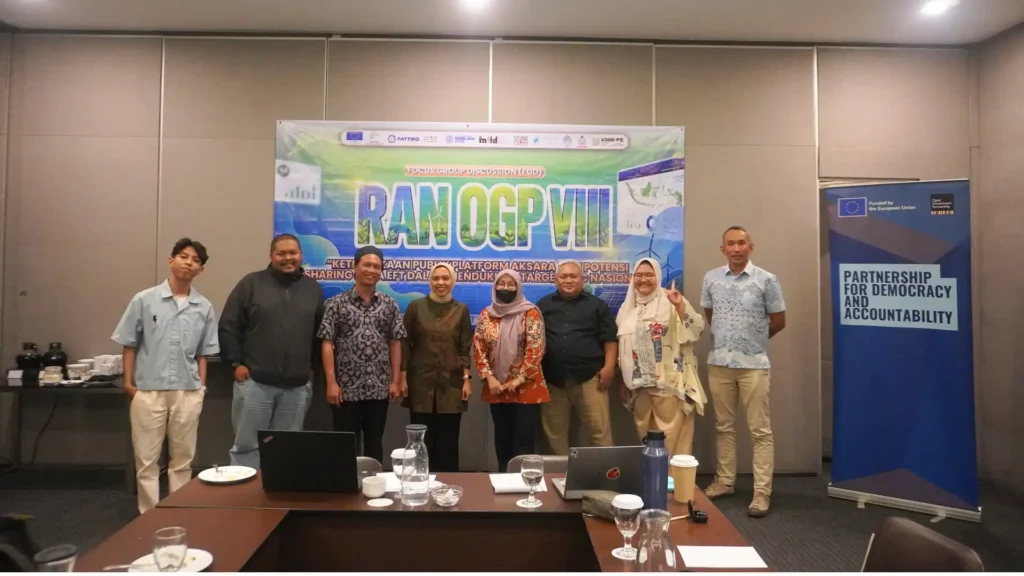
This FGD shows that AKSARA, EFT, and civil society data have opportunities to complement one another. However, the challenge ahead is not simply to enter ever more information into the platform. Data needs to be exchangeable without adding to the reporting burden, to be of verifiable quality, and to be open at a level that is genuinely useful to the public.
Ultimately, the public’s ability to monitor the NDC is not determined by the number of platforms available. What matters more is whether people can trace the links between targets, funding, action, achievements, and impact. When those links can be seen more openly, AKSARA and EFT data can evolve from mere information systems into instruments that strengthen participation and accountability in achieving the national NDC targets.